
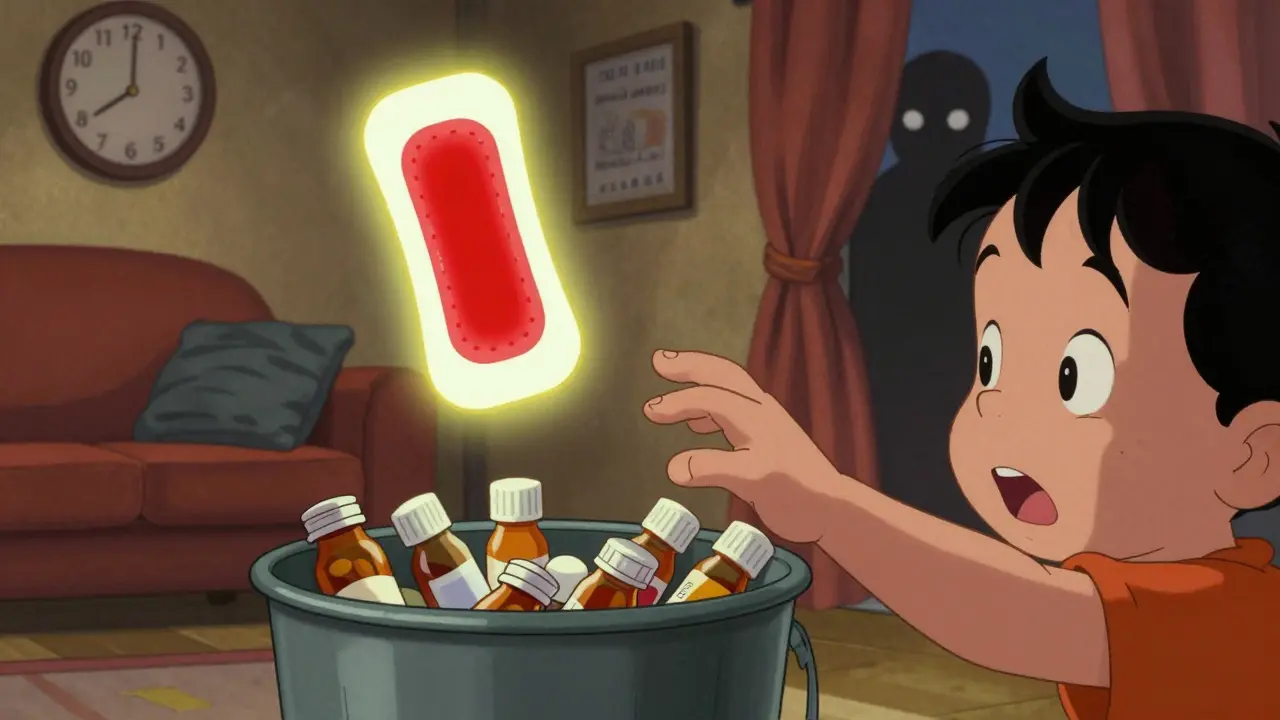
Putting old pills in the trash might seem harmless - but for some medications, it’s a dangerous mistake. In Australia and around the world, accidental poisonings, teen overdoses, and environmental harm are all linked to improper medicine disposal. The flush list from the U.S. Food and Drug Administration (FDA) isn’t just a guideline - it’s a life-saving rule. And while Australia doesn’t enforce the same list, the same risks exist here. If you have any of these medications at home, you need to know what to do - and what not to do.
Why Some Medications Should Never Go in the Trash
Not all expired drugs are the same. Most can be safely tossed after mixing with coffee grounds or cat litter. But a small group of medications can kill someone with just one dose. These are often powerful opioids, sedatives, or stimulants that are highly sought after for misuse. The FDA’s flush list includes drugs like fentanyl patches, methadone tablets, and oxymorphone capsules - all of which have caused fatal overdoses when found in household trash. In 2021, over 107,000 people in the U.S. died from drug overdoses. Nearly 70% of those involved prescription opioids. Many of these deaths happened because someone - often a child, teenager, or visitor - found a leftover pill in a trash bin. The Substance Abuse and Mental Health Services Administration (SAMHSA) found that more than half of people who misused painkillers got them from friends or family. That means your old medicine cabinet could be a source of harm, even if you think you’re being careful.The FDA Flush List: Exact Medications That Must Be Flushed
The FDA has published a clear list of medications that must be flushed down the toilet immediately. This isn’t a suggestion - it’s the only safe option for these drugs. Here’s the full list, based on FDA guidance updated in 2023:- Any medication containing buprenorphine (brand names: SUBOXONE, SUBUTEX, BELBUCA, BUTRANS, ZUBSOLV)
- Any medication containing fentanyl (brand names: DURAGESIC, ABSTRAL, ACTIQ, FENTORA, ONSOLIS)
- Hydromorphone (EXALGO)
- Meperidine (DEMEROL)
- Methadone (DOLOPHINE, METHADOSE)
- Morphine (ARYMO ER, AVINZA, EMBEDA, KADIAN, MORPHABOND ER, MS CONTIN, ORAMORPH SR)
- Oxymorphone (OPANA, OPANA ER)
- Tapentadol (NUCYNTA, NUCYNTA ER)
- Sodium oxybate (XYREM, XYWAV)
- Diazepam rectal gel (DIASTAT, DIASTAT ACUDIAL)
- Methylphenidate transdermal system (DAYTRANA)
These aren’t random choices. Each one has two things in common: it’s highly addictive, and a single dose can stop someone’s breathing. Fentanyl, for example, is 50 to 100 times stronger than morphine. A patch meant for chronic pain can kill a child who finds it in the trash.
What to Do If You Have One of These Medications
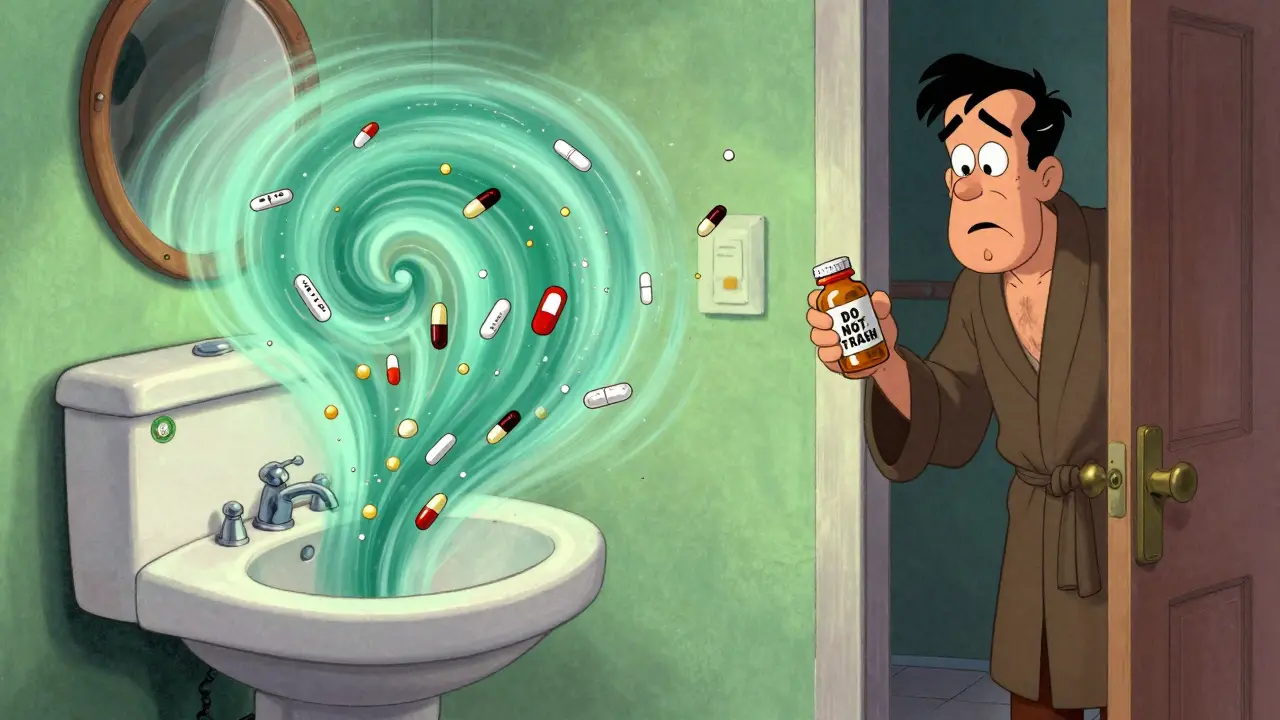
If you have any of these drugs - even one pill or one patch - and you no longer need them, flush them right away. No waiting. No storing. No mixing with coffee grounds. Just take the medication, remove it from its packaging if possible, and drop it straight into the toilet. Flush once. Done.This might feel wrong. You’ve been told for years that flushing is bad for the environment. And yes, trace amounts of drugs can end up in water systems. But here’s the hard truth: the risk of death from accidental exposure is far greater than the environmental impact. The EPA and FDA agree: for these specific drugs, the toilet is the safest option.
Dr. John Scott from the EPA’s National Homeland Security Research Center put it plainly: “The environmental impact of flushing one fentanyl patch is negligible compared to the risk of multiple deaths if it’s found in a trash can.”
What to Do With All Other Medications
For everything else - antibiotics, blood pressure pills, antidepressants, pain relievers - you don’t flush. Instead, follow these steps:- Take pills out of their original bottles.
- Don’t crush tablets or capsules. Just leave them as they are.
- Mix them with something unappealing - used coffee grounds, cat litter, or dirt.
- Put the mixture in a sealed plastic bag or container.
- Throw it in your household trash.
This makes the medicine unattractive and hard to recover. It’s not perfect, but it’s the best option when flushing isn’t required. Never pour liquid medications down the sink or toilet unless it’s on the flush list.
What About Australia? Do We Have a Flush List?
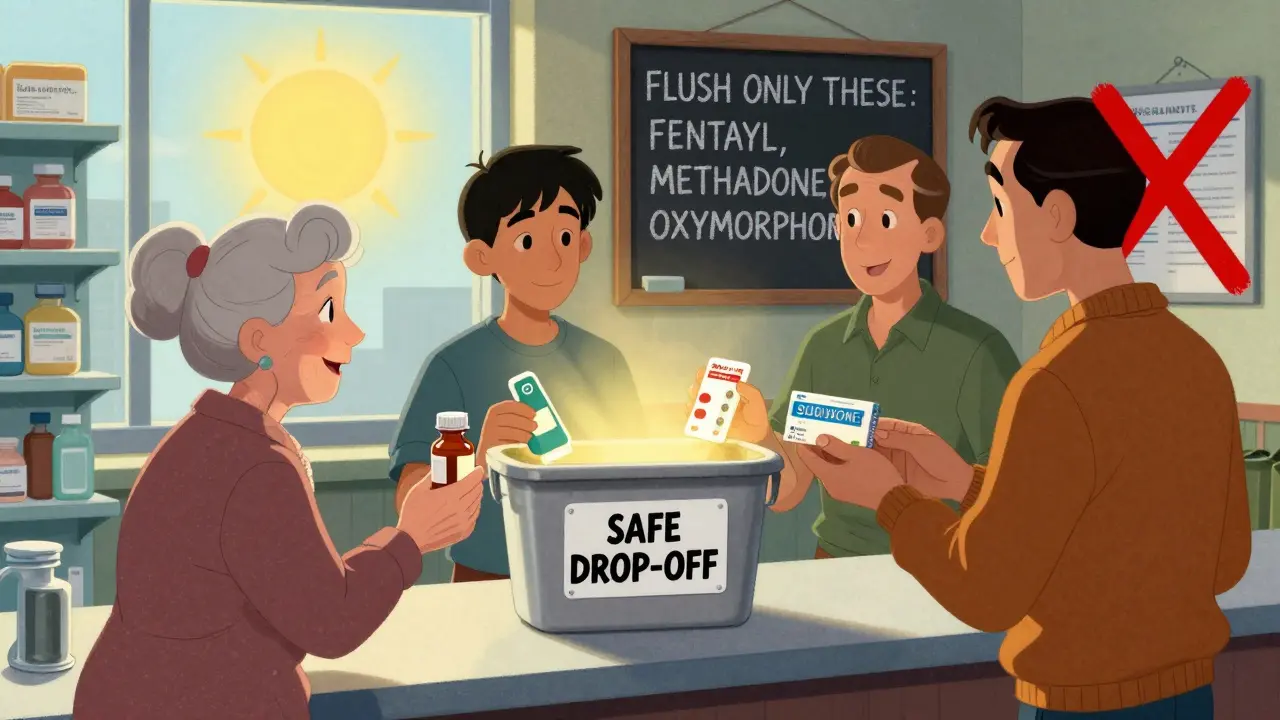
Australia doesn’t have an official flush list like the U.S. But the same dangers exist. The Therapeutic Goods Administration (TGA) recommends using community take-back programs whenever possible. Many pharmacies across Melbourne and other cities offer free disposal bins - often in partnership with local councils or police. If you can’t get to a drop-off point and you have a medication that’s on the FDA list (like fentanyl or methadone), flushing is still the safest choice. The TGA doesn’t prohibit flushing in these cases. In fact, their guidelines say: “If there is a risk of harm from accidental exposure, immediate disposal by flushing may be appropriate.”Where to Drop Off Medicines in Australia
You don’t have to flush. There are better options - if you know where to look:- Pharmacies: Most major chains like Chemist Warehouse, Pharmacy Guild, and independent pharmacies have take-back bins. Just ask at the counter.
- Local councils: Many Melbourne councils (like Yarra, Port Phillip, and Boroondara) run periodic medicine collection events.
- Police stations: Some stations accept unused medications, especially controlled drugs. Call ahead to confirm.
- Hospital pharmacies: Public hospitals often have disposal programs for patients.
These programs are free, safe, and environmentally sound. They’re the ideal solution - if you can get there.
The Real Problem: People Don’t Know Which Ones to Flush
A 2022 study found that only 43% of patients could correctly identify which medications needed flushing. That’s scary. Many people think all pills should be thrown away the same way. Others avoid flushing entirely out of fear of harming the environment. The result? Kids find fentanyl patches. Teens steal oxymorphone from the trash. Elderly relatives accidentally ingest leftover methadone. The American Association of Poison Control Centers reported over 8,900 cases in 2022 where children under five were exposed to prescription drugs - mostly from trash or unsecured cabinets. In Australia, similar incidents are underreported, but the risk is real.What’s Changing? New Solutions Are Coming
More pharmacies are starting to use “dispose-ready” packaging. These are special envelopes or pouches that contain activated charcoal. When you add water, the medicine becomes unusable. One pilot program in the U.S. cut improper disposal by 63%. Australia is watching closely. Also, new laws are being considered. In the U.S., the SNIPED Act would require doctors to give disposal instructions with every prescription for strong painkillers. Australia may follow. For now, the responsibility falls on you.Final Rule: When in Doubt, Flush the Strong Ones
If you’re unsure whether a medication is dangerous enough to flush, ask yourself: Could this kill someone with just one dose? If the answer is yes - flush it. Fentanyl. Methadone. Oxymorphone. Buprenorphine. These aren’t just drugs. They’re potential weapons in the wrong hands.For everything else - mix, seal, trash. Use a drop-off bin if you can. But never assume it’s safe to toss just because it’s old. Some pills are more dangerous than you think.
Can I flush all my old medications down the toilet?
No. Only medications on the FDA flush list should be flushed. That includes fentanyl, methadone, oxymorphone, and a few others. For all other drugs, mix them with coffee grounds or cat litter, seal them in a plastic bag, and throw them in the trash. Flushing non-listed drugs can harm water systems and is not recommended.
What if I can’t find a medicine take-back bin in my area?
If you have a medication on the flush list, flush it immediately. For all other medications, mix them with an unappealing substance like dirt or used coffee grounds, seal them in a plastic bag, and put them in your household trash. This is the safest method if no drop-off option is available.
Is flushing medicine bad for the environment?
Yes, flushing can lead to trace amounts of drugs in waterways. But for the medications on the flush list, the risk of accidental death - especially in children or people with substance use disorders - is far greater than the environmental impact. The FDA and EPA agree that for these specific drugs, flushing is the lesser of two harms.
Why are some medications on the flush list and not others?
The FDA includes only medications that are both highly addictive and deadly in a single dose. For example, one fentanyl patch can kill a child. Other drugs, like antibiotics or blood pressure pills, aren’t sought after for misuse and aren’t lethal in small amounts, so they’re safe to dispose of in trash after mixing with an unappealing substance.
Can I just throw away a pill bottle without removing the pills?
No. Always remove pills from their original containers. The bottles can be recycled if cleaned, but the pills must be taken out and mixed with an unappealing substance like cat litter or coffee grounds. Leaving pills in their bottles makes it easy for someone to recover and misuse them.
Liam Crean
I never realized how many people just toss old pills in the trash like it’s no big deal. I’ve got a fentanyl patch sitting in my cabinet right now-never thought about flushing it until I read this. Honestly, it’s kind of terrifying to think a kid could find it and die from one touch. I’m flushing it tonight. No excuses.
Also, I’m gonna check my mom’s medicine cabinet next weekend. She’s got a bunch of old painkillers from her knee surgery. She thinks ‘mixing with coffee grounds’ is enough. It’s not.
Jeremy Williams
While I appreciate the intent behind this public health initiative, I must express concern regarding the normalization of pharmaceutical waste disposal via municipal sewage systems. The ecological burden of bioaccumulative compounds, even in trace concentrations, is not trivial. The EPA’s own data on endocrine disruptors in aquatic ecosystems suggests a non-linear risk profile. Flushing, while expedient, is a band-aid solution that defers systemic reform.
That said, I concede that in cases of high-toxicity opioids, the risk calculus may justify the intervention. But we must advocate for centralized take-back infrastructure-not individualized flushing rituals.
Ellen Spiers
Let’s be precise: the FDA’s flush list is not ‘life-saving,’ it’s a risk-mitigation protocol for a subset of Schedule II and III controlled substances. The conflation of ‘environmental harm’ with ‘accidental poisoning’ is a false dichotomy. Moreover, the claim that ‘trace amounts’ are ‘negligible’ is empirically dubious-pharmaceuticals have been detected in drinking water at sub-parts-per-billion levels in 80% of U.S. municipal supplies.
Furthermore, the assertion that ‘Australia doesn’t enforce the same list’ is misleading. The TGA explicitly endorses take-back programs as the primary disposal method. Flushing is a contingency, not a recommendation. The article’s tone is alarmist and lacks nuance.
Hariom Sharma
This is so important! I’m from India and we don’t have proper disposal systems here-people just dump pills in rivers or trash. I’m sharing this with my family right now. My uncle had a fentanyl patch after his surgery and he was going to throw it out. Now he’s taking it to the pharmacy tomorrow. Thanks for this post-it could save lives. Let’s spread awareness, not fear!
Also, if you’re in India and need help finding a drop-off, DM me. I’ll help you locate one.
Caleb Sciannella
It is imperative to underscore the gravity of pharmaceutical mismanagement in domestic environments, particularly given the escalating opioid crisis in North America. The data presented by SAMHSA and the CDC, which indicate that over 50% of nonmedical opioid users obtain substances from friends or family, is not merely anecdotal-it is a systemic failure of household-level pharmacovigilance.
Moreover, the environmental argument against flushing must be contextualized within the broader framework of risk prioritization. While aquatic contamination is a legitimate concern, the immediate threat of fatality due to accidental ingestion-particularly among pediatric populations-demands a utilitarian response. The EPA’s position, grounded in quantitative risk assessment, is both scientifically sound and ethically defensible in this specific context. We must not allow perfectionism to become the enemy of pragmatic safety.
Davis teo
OMG I just checked my bathroom cabinet and found THREE fentanyl patches from my dad’s old pain meds. I didn’t even know he had them. I flushed them immediately. I’m so shook. My little cousin was over last week and she was playing with the trash. I could’ve lost her.
Also-why isn’t this on the news? Why aren’t doctors giving out these lists like a checklist? This is wild. We need mandatory disposal instructions on every prescription. Like, right now. This isn’t just ‘good advice’-it’s a public safety emergency.
Marie Crick
If you’re not flushing these, you’re a danger to society. Period. You think you’re being responsible by tossing them in the trash? You’re just waiting for someone else’s kid to die because you were too lazy to flush a pill. You’re not ‘protecting the environment’-you’re gambling with lives. Stop pretending you’re ethical. You’re just scared of the toilet.
Tommy Chapman
Of course the FDA says flush-it’s a government program. Meanwhile, Australia’s got real solutions: take-back bins. Why are we letting American bureaucracy dictate our disposal? We don’t need to flush our meds like we’re in a dystopian sci-fi novel. We’ve got pharmacies, police stations, councils-use them. This whole ‘flush list’ thing feels like American fearmongering wrapped in a science blanket. Stop importing their panic.
Also, if you’re worried about kids, lock your cabinet. Don’t flush your way out of responsibility.
Nina Catherine
Wait wait wait-I just looked at my meds and I think I have one of those on the list?? I’m so bad at this. I’ve been mixing everything with cat litter like a good girl. Can someone tell me how to tell if it’s on the flush list? Like, is it just the brand names? I’m so scared I’m gonna accidentally kill someone. I’ll flush it if I need to, I just don’t know what to look for. 😭