

When a doctor prescribes a medication and the pharmacist gives you a different one, it’s natural to wonder: Is this safe? Did they just swap drugs randomly? The truth is, there’s a structured, evidence-based process behind many of these changes-and it’s called therapeutic interchange. But here’s the catch: it doesn’t mean switching from one drug class to another. That’s a common misunderstanding. Therapeutic interchange happens within the same class of drugs-like swapping one statin for another, or one SSRI for a different one-not from a blood pressure pill to a diabetes drug.
What Therapeutic Interchange Actually Means
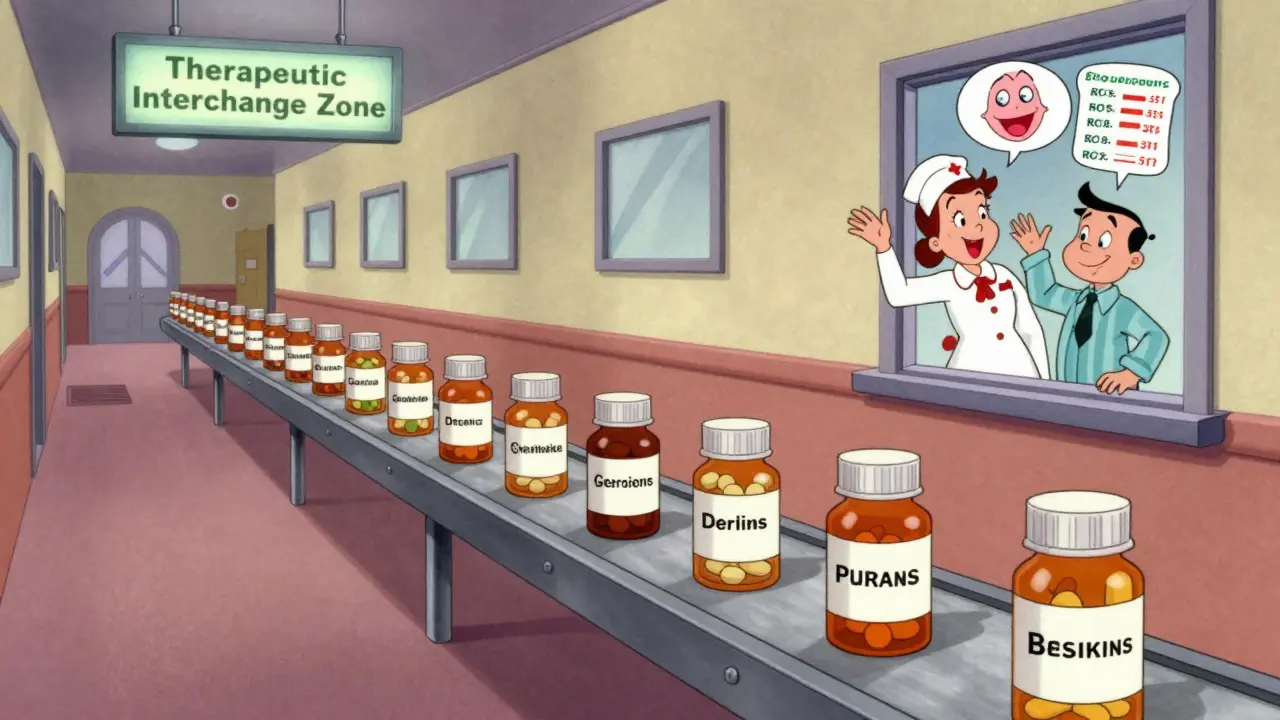
Therapeutic interchange isn’t a free-for-all. It’s a carefully controlled swap between two drugs that treat the same condition, work the same way in the body, and have been proven to deliver similar results. For example, if you’re prescribed atorvastatin for high cholesterol, your pharmacist might give you rosuvastatin instead. Both are statins. Both lower LDL. Both are in the same therapeutic class. But they’re chemically different. And one might be cheaper-or have fewer side effects-for you.
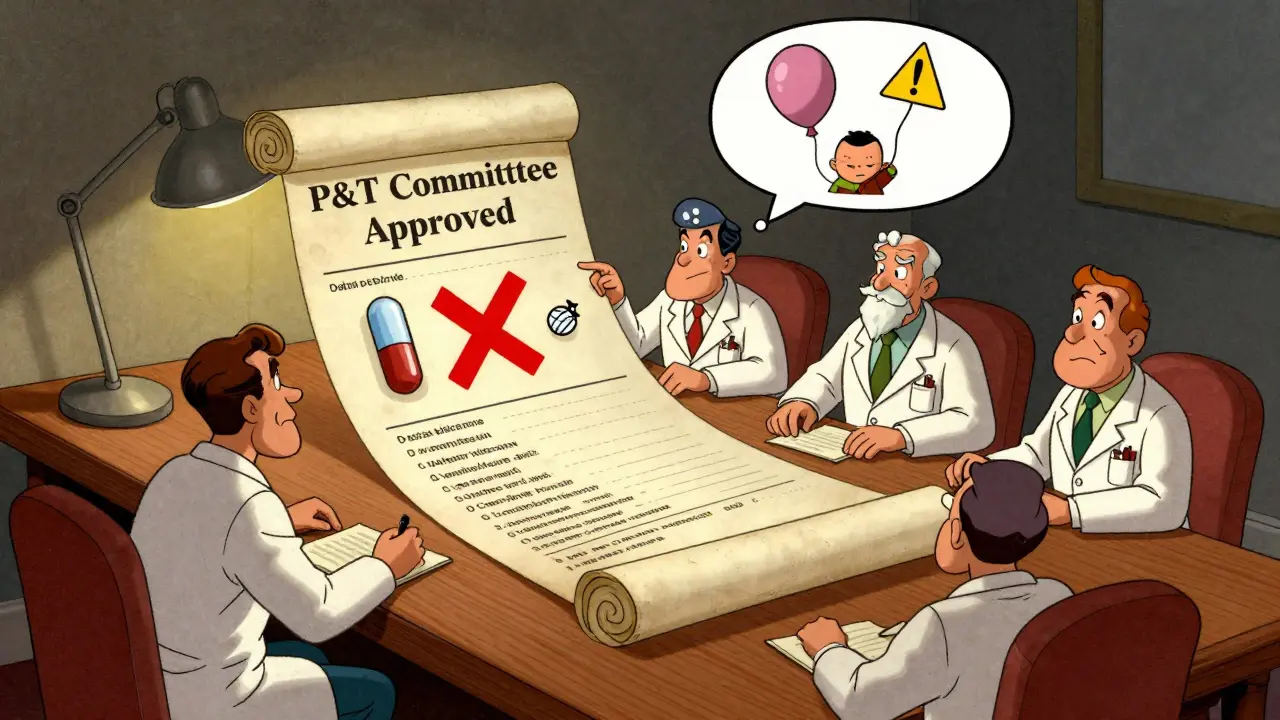
This isn’t random. It’s guided by a formulary-a list of approved medications used by hospitals, nursing homes, and sometimes insurance plans. These lists are built by Pharmacy and Therapeutics (P&T) Committees. These teams include pharmacists, doctors, nurses, and sometimes even patients. They review clinical data, cost, side effect profiles, and real-world outcomes before deciding which drugs make the cut. If two drugs are equally effective, they’ll often pick the lower-cost option. That’s where therapeutic interchange kicks in.
Contrast this with generic substitution. That’s when you get the exact same drug, just without the brand name. Like getting simvastatin instead of Zocor. Therapeutic interchange is different. You’re getting a different drug entirely-but one that does the same job. And it’s not something a pharmacist can decide on their own in most cases.
Who Decides and How It Works
Therapeutic interchange doesn’t happen in community pharmacies without permission. In most states, a pharmacist can’t just swap your lisinopril for ramipril without checking in with your doctor first. That’s because the decision isn’t about pharmacy policy-it’s about clinical judgment. The process usually starts with the facility’s P&T Committee approving a list of acceptable substitutions. Once approved, pharmacists can make the switch, but they must document it and notify the prescriber.
In hospitals and long-term care facilities, this system runs smoothly. Over 80% of U.S. hospitals have had therapeutic interchange programs since at least 2002. In skilled nursing homes, where residents take multiple medications daily, these swaps can save tens of thousands of dollars each month. A patient on expensive brand-name metoprolol might be switched to generic carvedilol, which has similar heart benefits but costs far less. The goal isn’t to cut corners-it’s to deliver the same outcome at a lower price without risking safety.
But here’s the reality: not every prescriber is on board. Some doctors prefer to stick with what they know. Others worry about liability or patient confusion. That’s why many facilities require a signed “TI letter”-a formal agreement from the prescriber that allows the pharmacy to make future substitutions automatically. Once that’s in place, every time that patient’s prescription comes in, the pharmacy can fill it with the approved alternative. No phone calls. No delays. Just smoother care.
Why It Doesn’t Work Across Drug Classes
You might hear someone say, “My doctor switched me from a beta-blocker to a calcium channel blocker.” That’s not therapeutic interchange. That’s a clinical decision based on changing needs-maybe your blood pressure wasn’t controlled, or you had side effects. Therapeutic interchange doesn’t apply here. The drugs are in different classes. They work differently. One blocks adrenaline; the other relaxes blood vessels. They’re not interchangeable in the technical sense.
Experts are very clear on this. The American College of Clinical Pharmacy defines therapeutic interchange strictly as substitution within the same class. Any attempt to swap between classes is a treatment change, not an interchange. Mixing these up can lead to dangerous assumptions. For example, switching from a diuretic to an ACE inhibitor because they’re both “blood pressure meds” could cause serious harm if the patient has kidney issues or high potassium. The system only works when the drugs are truly comparable in effect, safety, and mechanism.
Where It Works Best-and Where It Falls Short
Therapeutic interchange shines in institutional settings: hospitals, nursing homes, VA facilities, and large clinics with centralized formularies. These places have the infrastructure to track outcomes, monitor side effects, and update protocols regularly. Pharmacists are embedded in care teams. Data is collected. Adjustments are made.
But in a busy community pharmacy? It’s rare. Why? Because there’s no pre-approved formulary. No P&T committee. No signed TI letter. And most state laws require pharmacists to contact the prescriber before making any substitution that isn’t a generic equivalent. That means a pharmacist might have to call your doctor, explain the rationale, wait for approval, and then wait for the new prescription to come through. It’s slow. It’s frustrating. And it defeats the purpose of efficiency.
That’s why therapeutic interchange isn’t a tool for retail pharmacies. It’s a system designed for environments where care is coordinated, protocols are documented, and teams work together. Outside of that, it’s not practical-and it shouldn’t be forced.
What Patients Should Know
If you’re handed a different pill than what your doctor wrote, ask: “Is this a generic version, or is it a different drug?” If it’s a different drug, ask: “Is this part of a formulary swap? Has my doctor approved this?” Most of the time, if it’s a therapeutic interchange, your provider has already agreed to it. But you have the right to know.
Don’t assume it’s safe just because it’s “the same class.” Even within a class, drugs vary. One might cause more dizziness. Another might interact with your other meds. Always check with your pharmacist or doctor if you’re unsure. And if you notice new side effects after a switch, report them. Therapeutic interchange is meant to improve care-not create new problems.
The Bigger Picture: Cost, Quality, and Control
Drug prices keep climbing. In 2018 alone, U.S. drug prices rose 8%. That’s why therapeutic interchange exists-not to cut corners, but to keep care affordable without sacrificing outcomes. In long-term care, where one resident might be on ten different medications, small savings add up fast. A single monthly switch from a $200 brand to a $30 generic equivalent can save a facility thousands. That money can go toward more nursing staff, better meals, or physical therapy.
But the real win isn’t the cost. It’s consistency. When a facility uses a standardized formulary, every patient gets the same evidence-based options. No more random prescribing. No more “my doctor likes this one.” It levels the playing field. And when patients are included in the conversation-when their preferences and concerns are heard-it becomes patient-centered care, not just cost-cutting.
What’s Next for Therapeutic Interchange?
The future isn’t about expanding into new drug classes. That would be a mistake. The future is about refining the system. Better data. Smarter formularies. More input from patients and caregivers. Some states are updating their laws to make therapeutic interchange easier in institutional settings while keeping strict controls in retail pharmacies.
What won’t change is the core rule: therapeutic interchange stays within the same class. It’s not a loophole. It’s a tool. And like any tool, it only works when used the right way.



Gary Hartung
Oh, so now we’re just swapping statins like trading Pokémon cards? 🤡 I mean, sure, rosuvastatin and atorvastatin are ‘the same class’-but have you SEEN the side effect profiles? One makes you feel like a zombie, the other makes your muscles scream at 3 a.m. This isn’t ‘evidence-based’-it’s corporate cost-cutting dressed up in white coats.
And don’t even get me started on the ‘P&T Committees’-who’s on those? Pharma reps with Excel sheets and a vendetta against generics? I’ve seen formularies change because some VP’s cousin owns stock in a generic manufacturer. This isn’t medicine-it’s a spreadsheet with a stethoscope.
And yes, I’ve been switched. Twice. Both times, I ended up in the ER. So don’t tell me it’s ‘safe.’ It’s convenient. For them.
Also, why is no one talking about the fact that these ‘swaps’ never happen for insulin? Or antiretrovirals? No. Only the ‘low-hanging fruit’ meds. Hmm.
And don’t give me that ‘patient-centered care’ nonsense. My voice was never asked. My pharmacist didn’t call. My doctor didn’t even know. So… who’s centering whom?
It’s not therapeutic interchange. It’s therapeutic exploitation. And we’re all just the cost centers.
Also-why does this feel like a Netflix doc? Someone call Jon Ronson. We’ve got material.
Ben Harris
Bro the whole system is rigged you know that right
They swap your meds because they can and then you get weird side effects and no one takes responsibility
My uncle died after they switched his blood pressure med to some cheap generic and no one even told his family
Its not about safety its about profit and you know it
Oluwatosin Ayodele
Actually in Nigeria, therapeutic interchange is almost nonexistent because most facilities can’t afford even one brand of each drug class, let alone multiple options. So when a patient gets switched, it’s not because of formularies-it’s because the shipment of the original drug never arrived.
What you call ‘evidence-based’ here is a luxury. In Lagos, if the pharmacy has any statin, you take it. No P&T committee. No TI letter. Just ‘here’s what we have.’
But the core idea-using cheaper alternatives when clinically equivalent-is sound. It’s just that in high-income countries, the bureaucracy turns a simple cost-saving tool into a political battlefield.
Also, the real issue isn’t the swap-it’s that drug pricing is broken. Fix that, and no one needs to ‘interchange’ anything. Just pay fair prices.
And yes, I’ve seen patients die because they couldn’t afford the brand. So don’t act like this is just about American healthcare drama.
Jason Jasper
I’ve worked in a VA hospital for 12 years. We use therapeutic interchange daily. And honestly? It works. Not because we’re trying to save money-but because we’re trying to standardize care.
One of our veterans was on four different statins over five years because each prescriber had their ‘favorite.’ Then we implemented a formulary. Now everyone gets the same one. Fewer interactions. Fewer errors. Less confusion.
And yes, we notify the prescriber. We track outcomes. We include patients in the decision. It’s not perfect. But it’s better than the chaos before.
Therapeutic interchange isn’t about cutting corners. It’s about cutting noise. And if you’re worried about side effects? Talk to your pharmacist. They’re the ones who actually know the differences between the drugs.
Also, the fact that this is even controversial shows how broken our prescribing culture is.
Mussin Machhour
Y’all are overthinking this. Look-pharmacists aren’t out here playing doctor. They’re following protocols approved by teams of actual medical pros. If your doc signed off on a TI letter, that means they already vetted the swap.
And yes, it’s cheaper. But cheaper doesn’t mean worse. It means more people can get treated. That’s a win.
Also-have you ever tried to get a refill on a $200 pill when you’re on SSDI? Yeah. It’s brutal. This system lets people stay on meds. That’s the goal.
Stop treating every cost-saving move like a conspiracy. Sometimes, the system actually works. And sometimes, it’s not evil-it’s just practical.
Carlos Narvaez
Therapeutic interchange is not substitution. It’s optimization. And if you can’t tell the difference between a statin and a beta-blocker, you shouldn’t be commenting on this.
Also, the fact that you think this is new is laughable. It’s been standard since the 80s in institutional care.
Stop panicking. Read the literature.
And yes, it’s legal. And yes, it’s evidence-based.
Case closed.
Harbans Singh
Hey, I’m from India and we don’t have this system-but we have something similar called ‘generic substitution.’ It’s not always perfect, but it saves lives.
My mom was on a brand-name antihypertensive that cost half her pension. Then we switched to a generic equivalent-same active ingredient, same results. She’s fine now.
Therapeutic interchange is just a fancy term for doing the same thing but with more layers of approval. The goal is the same: give people the medicine they need without bankrupting them.
Maybe the problem isn’t the swap-it’s that we don’t talk to patients enough. Ask them how they feel after the switch. Listen. That’s the real ‘evidence’ we need.
Also, can we please stop calling pharmacists ‘just pharmacists’? They’re the ones catching the errors. They deserve more credit.
Justin James
Okay, but what if this is all part of a larger agenda? You know the CDC, the AMA, and Big Pharma are all connected through the same funding streams. They’ve been pushing this ‘interchange’ nonsense since the 90s to normalize drug dependency under the guise of ‘efficiency.’
Did you know that the original formulary lists were drafted by lobbyists from Pfizer and Merck? The ‘P&T Committees’? Half of them have stock options in generic manufacturers. It’s a shell game.
And why do they always pick the cheapest option? Because they’re not looking for clinical equivalence-they’re looking for the drug with the highest rebate from the manufacturer. That’s not medicine. That’s accounting.
And then they tell you it’s ‘safe’ because ‘studies show’-but those studies were funded by the same companies that profit from the swap.
My cousin got switched to a generic SSRI and developed suicidal ideation. The doctor said ‘it’s the same thing.’ It’s not. The fillers are different. The absorption rates are different. The placebo effect is different. And no one tracks long-term outcomes because the FDA doesn’t require it.
This isn’t healthcare. It’s a financial algorithm with a prescription pad.
Zabihullah Saleh
There’s something beautiful about this idea, honestly. The notion that medicine can be standardized-not to homogenize, but to democratize. That a person in rural Kentucky and a veteran in Chicago can get the same effective treatment because a team of professionals sat down, looked at data, and said, ‘This one works just as well, and it costs less.’
It’s not about cutting corners. It’s about lifting the ceiling so more people can reach it.
But you’re right to be wary. Because when systems get too focused on efficiency, they forget the human. The fear. The confusion. The silence after a pill is swapped and no one checks in.
So maybe the real question isn’t whether therapeutic interchange works.
It’s whether we’re willing to listen to the people it affects.
And if we are… we’ll make it better. Not just cheaper. Better.