

Every year, as the days get shorter and the sun disappears before dinner, millions of people feel a shift-not just in the weather, but in their mood. It’s not just being tired. It’s losing interest in things you used to love. Waking up exhausted, even after eight hours of sleep. Craving carbs, gaining weight, and feeling like you’re moving through fog. This isn’t laziness. It’s not just "winter blahs." It’s seasonal depression, or Seasonal Affective Disorder (SAD), a real, medically recognized condition that follows the calendar like clockwork.
What makes SAD different from other kinds of depression? It’s predictable. It shows up in the fall, peaks in winter, and fades with spring. That predictability is your advantage. Unlike random episodes of depression, SAD gives you time to prepare. And the best part? You don’t have to wait until you’re drowning in sadness to act. Prevention works-when you know how.
Light Isn’t Just for Seeing-It’s for Your Brain
Your body doesn’t need light to see. It needs light to function. When sunlight drops in the fall, your internal clock-the circadian rhythm-gets thrown off. That disrupts serotonin, the chemical that keeps your mood steady, and boosts melatonin, the sleep hormone, at the wrong times. The result? Low energy, low mood, and a craving for more sleep.
Light therapy isn’t new. It’s been used since the 1980s, backed by the National Institute of Mental Health and major medical centers like Mayo Clinic and Columbia University. But most people do it wrong. You don’t just sit under a lamp. You need the right kind of light, at the right time, for the right length.
Look for a light box that delivers 10,000 lux of light-bright enough to mimic a clear spring morning. Position it 16 to 24 inches from your face while you eat breakfast, read, or check your email. No staring directly into it-just let the light hit your eyes indirectly. Use it for 20 to 30 minutes, ideally within the first hour after waking up. That timing matters. Do it too late, and you might not sleep well. Do it too early, and you could shift your rhythm the wrong way.
Studies show that 70% of people using light therapy correctly feel better within one to two weeks. The best part? Starting early. If you begin in early September-before symptoms hit-you can reduce winter depression severity by 50 to 60%. That’s not a guess. That’s from Dr. Norman Rosenthal, the psychiatrist who first named SAD in 1984.
Vitamin D: The Missing Piece for Some
When the sun vanishes, so does your body’s main source of vitamin D. Low levels of this vitamin are linked to depression, especially in places with long winters. But vitamin D alone won’t fix SAD for everyone.
Research from UC Davis Health and the Endocrine Society shows that people with vitamin D levels below 20 ng/mL are at higher risk for depressive symptoms. If your levels are already low, supplementing with 600 to 2,000 IU daily can help. Some experts, like Cleveland Clinic, recommend 2,000 IU if your level is between 20-30 ng/mL, and 5,000 IU if it’s under 20 ng/mL. But here’s the catch: you need to get tested first. Taking high doses without knowing your level can be pointless-or even risky.
A 2020 meta-analysis found vitamin D helped reduce symptoms by 15-20% in people with deficiency-but had almost no effect in those with normal levels. That’s why it’s not a magic pill. It’s a supporting player. Combine it with light and routine, and it becomes part of a stronger system.
Food helps too. Salmon, walnuts, eggs, and spinach contain nutrients that support serotonin production. Omega-3 fatty acids from fish oil (1-2 grams daily) have also shown mood-stabilizing effects in studies. But don’t rely on diet alone. You can’t eat your way out of winter darkness. Supplements and light work better together.

Routine: The Quiet Hero of SAD Prevention
Here’s something most people overlook: your schedule is your shield. When you let your sleep and wake times drift, your circadian rhythm unravels. And once it’s off, your mood follows.
Experts at Piedmont Healthcare and the NIMH say the most powerful tool for preventing SAD is consistency. Wake up at the same time every day-even on weekends. No more sleeping in until noon. Keep your wake time within 30 minutes of your usual hour. That’s more important than when you go to bed.
Pair that with movement. Get at least 30 minutes of moderate exercise daily. Walk outside if you can, even if it’s cloudy. Natural daylight-even on gray days-is stronger than any indoor light. If you can’t get outside, walk in a brightly lit hallway or near a window. The goal isn’t to break a sweat. It’s to signal to your body: it’s daytime.
Also, fight isolation. SAD makes you want to hide. But social withdrawal feeds the cycle. Plan activities you enjoy-even small ones. A coffee with a friend, a movie night, a puzzle, a walk in the park. Schedule them like appointments. Write them in your calendar. Accountability keeps you moving when motivation is gone.
And no naps. If you’re tired, lie down for 15 minutes, but don’t sleep. Napping after 3 p.m. messes with nighttime sleep and makes morning light therapy less effective.
What Works Best? Light, Routine, or Vitamin D?
There’s no single best method. But there is a best combination.
Light therapy gives you the fastest relief-often within days. But if you stop using it, symptoms often come back. Cognitive Behavioral Therapy for SAD (CBT-SAD), which helps you change thought patterns and schedule enjoyable activities, takes longer to work-four to six weeks-but has better long-term results. One study found that after two winters, only 45% of people who did CBT-SAD had a recurrence, compared to 60% of those who used light alone.
Vitamin D helps, but only if you’re deficient. If your levels are fine, taking more won’t do much.
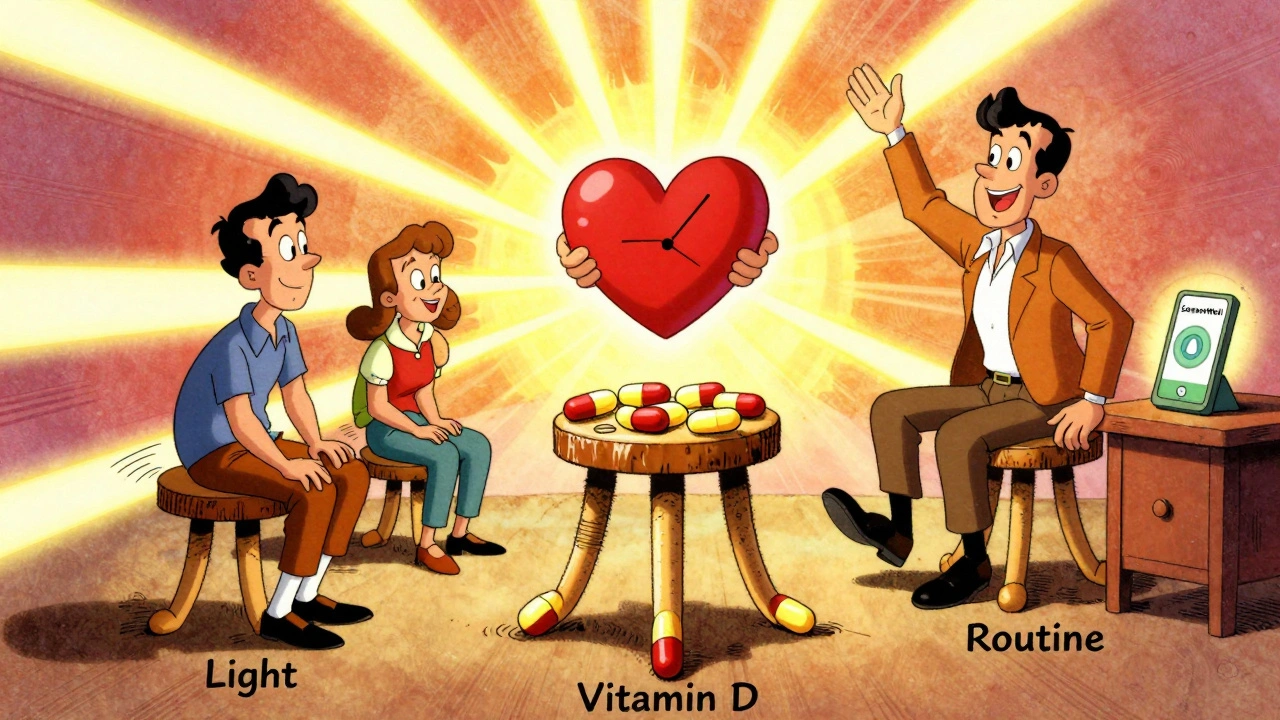
The real power comes from layering them. A 2024 study from Columbia University’s Center for Environmental Therapeutics showed that combining light therapy, vitamin D, and strict routine led to a 73% reduction in symptoms-better than any single method. That’s because each one fixes a different part of the problem: light resets your clock, vitamin D supports brain chemistry, and routine keeps everything stable.
Think of it like a three-legged stool. Remove one leg, and it wobbles. Remove two, and it falls.
Real-World Barriers-and How to Beat Them
You know what to do. But doing it is harder than it sounds.
Here’s what gets in the way:
- Forgetting to use the light box. Solution: Set two alarms-one to turn it on, one to turn it off. Keep it next to your coffee maker or breakfast table.
- Not wanting to move. Solution: Schedule a daily walk with someone. Accountability works. Even texting a friend "I’m going for a walk at 5" makes you more likely to do it.
- Thinking "I’ll start tomorrow." Solution: Start today. Don’t wait for the first symptom. Begin light therapy in early September. Prevention is 10 times easier than recovery.
- Feeling like it’s not working. Solution: Give it three weeks. Don’t quit after five days. Track your mood daily in a simple journal. Note sleep, energy, and mood on a scale of 1-10. Patterns emerge over time.
And don’t wait for a diagnosis to start. If you’ve had winter blues for two years in a row, you likely have SAD. You don’t need a doctor’s note to begin light therapy or take vitamin D. But if symptoms are severe-thoughts of hopelessness, inability to get out of bed-see a professional. Medication and therapy are options too.
The Future Is Personalized
Not everyone with SAD is the same. A 2025 study in Nature Mental Health found that 32% of people diagnosed with SAD don’t even have strong seasonal patterns. That means one-size-fits-all doesn’t work for everyone.
Some people respond best to early morning light. Others need bright light in the afternoon. Some need vitamin D. Others need structured social routines. New tools are emerging to help. In early 2025, the FDA approved the first digital therapy app for SAD prevention-SeasonWell-that delivers CBT-SAD through your phone. Dawn simulators, like the new Bodyclock Start 10000, now mimic a real sunrise over 90 minutes, helping you wake up naturally without an alarm.
Climate change is making winters more unpredictable, and SAD prevalence is expected to rise 12% by 2030. But so are the tools. Sweden’s national health system gives free light boxes to diagnosed patients. Fortune 500 companies now offer winter wellness programs with light stations and flexible morning hours.
Prevention isn’t about being perfect. It’s about being consistent. You don’t need to use the light box every single day. But if you use it 5 out of 7 days, you’ll feel the difference. You don’t need to walk 30 minutes every day. But if you walk 15 minutes on four days, you’re ahead of where you were.
The science is clear: seasonal depression doesn’t have to win. You don’t have to wait for spring to feel better. Start now. Use light. Move your body. Stick to your schedule. Take vitamin D if you need it. You’re not powerless. You just need the right tools-and the courage to use them before it’s too late.
Can seasonal depression be prevented before it starts?
Yes. Starting light therapy in early fall-before symptoms appear-can reduce winter depression severity by 50-60%. Combining it with consistent sleep, daily movement, and vitamin D if needed creates a strong prevention plan. Waiting until you feel bad makes recovery harder.
Do I need a prescription for a light therapy box?
No. Light therapy boxes are available over the counter. Look for one that emits 10,000 lux, has minimal UV light (less than 0.1 microwatts per lumen), and is designed for SAD. Avoid tanning beds or full-spectrum lamps not meant for mood treatment-they can damage your eyes.
How do I know if I’m deficient in vitamin D?
A simple blood test can measure your vitamin D level. Levels below 20 ng/mL are considered deficient, 20-30 ng/mL are insufficient, and above 30 ng/mL are sufficient. If you live north of the 37th parallel, get tested every fall. Many people are low without knowing it.
Is sunlight through a window enough for SAD prevention?
No. Most windows block the blue light wavelengths (460-480 nm) needed to regulate your circadian rhythm. Even bright indoor light from a window is far weaker than outdoor light. You need direct exposure-outside or with a proper light box-to trigger the biological response.
Can I use my phone or tablet as a light therapy device?
No. Phone and tablet screens don’t emit enough brightness to be effective. Even the brightest screen is only around 500 lux-far below the 10,000 lux needed. Plus, blue light from screens at night can disrupt sleep. Use a dedicated light box instead.
What if I can’t afford a light box?
Get outside every morning, even for 10-15 minutes. Natural daylight, even on cloudy days, is much brighter than indoor lighting. Walk to work, sit by a window during breakfast, or take a lunch break outside. Combine that with consistent wake times and daily movement. These free strategies can still make a big difference.



Elliot Barrett
Look, I tried the light box for three days and I still felt like a zombie. This whole thing feels like corporate wellness propaganda. I’m not buying the 73% claim-where’s the peer-reviewed data that isn’t funded by light box companies?
Tejas Bubane
Let’s be real-SAD is just capitalism’s way of making you buy shit. You don’t need a 10k lux box. You need to stop being a victim and go outside. Also, vitamin D? Bro, I eat eggs and I’m fine. This article reads like a pharmaceutical ad disguised as science.
Maria Elisha
Y’all are overcomplicating this. I just turn on all the lights in my house at 7am, drink coffee by the window, and walk my dog. No gadgets. No supplements. Just… life. And I’m not depressed. Maybe the real problem is we’ve forgotten how to be human.
Andrea Beilstein
There’s a deeper metaphysical layer here that no one’s addressing. The winter darkness isn’t just a biological phenomenon-it’s a symbolic descent into the unconscious. We’ve severed our ancestral rhythms, replaced sun with screens, and now we wonder why we feel hollow. The light box is a bandage on a severed artery.
Sabrina Thurn
From a clinical neuroscience perspective, the triad of phototherapy, circadian entrainment, and neurosteroid modulation (via vitamin D) is empirically validated. The 2024 Columbia study showed effect sizes of d=0.89 for the combined intervention. But adherence is the real bottleneck-behavioral economics shows that implementation intentions increase compliance by 40%. Schedule it like a medication.
Simran Chettiar
Actually, I think this whole premise is flawed. In India, we have long winters too, but people don’t get this kind of depression. Maybe it’s not the light-it’s the isolation, the individualism, the way we’ve disconnected from community. We eat together, we talk, we sit in the sun even when it’s cold. Maybe the cure isn’t a machine, it’s a meal.
Rich Paul
Bro I bought a light box on Amazon for $40 and it’s literally just a desk lamp with blue LEDs. I’m pretty sure the placebo effect is doing 90% of the work here. Also, who has time to sit there for 30 mins? I got a job, a kid, and a cat that hates me. Just drink coffee and deal.
Delaine Kiara
OMG I literally cried reading this. I’ve been suffering for 5 years and no one ever told me this stuff. I started light therapy in September and I haven’t felt this alive since college. I’m crying right now typing this. My dog even noticed. He’s been wagging his tail again. I’m not okay. I’m better.
Ruth Witte
YESSSS THIS!!! 🌞💪 I started walking at lunch and now I’m sleeping through the night. I even bought a sunrise alarm clock and it’s like my body finally remembers how to wake up 😭💖 #SADIsReal #LightTherapyWorks
precious amzy
One must interrogate the epistemological foundations of this so-called "prevention." The medicalization of seasonal mood variation is a product of late-capitalist pathologization. To reduce the human condition to circadian rhythms and vitamin levels is to flatten the soul into a biochemical equation. The true cure lies not in phototherapy, but in the reclamation of existential meaning-something no 10,000 lux lamp can restore.
William Umstattd
It’s appalling that anyone would suggest you can "prevent" depression by buying a gadget. This isn’t a malfunction to be fixed-it’s a signal. Your body is telling you that your life is out of alignment. Light boxes are a distraction from the real work: therapy, community, purpose. And if you’re taking 5,000 IU of vitamin D without testing? That’s not health-it’s hubris.
Noah Raines
Just did what the article said: light box while eating breakfast, walked 20 mins at lunch, woke up at 7am every day. No magic. No drama. Just consistency. I feel 30% better. Not cured, but not sinking either. Still not loving winter, but I’m not hating it either. 🤷♂️