
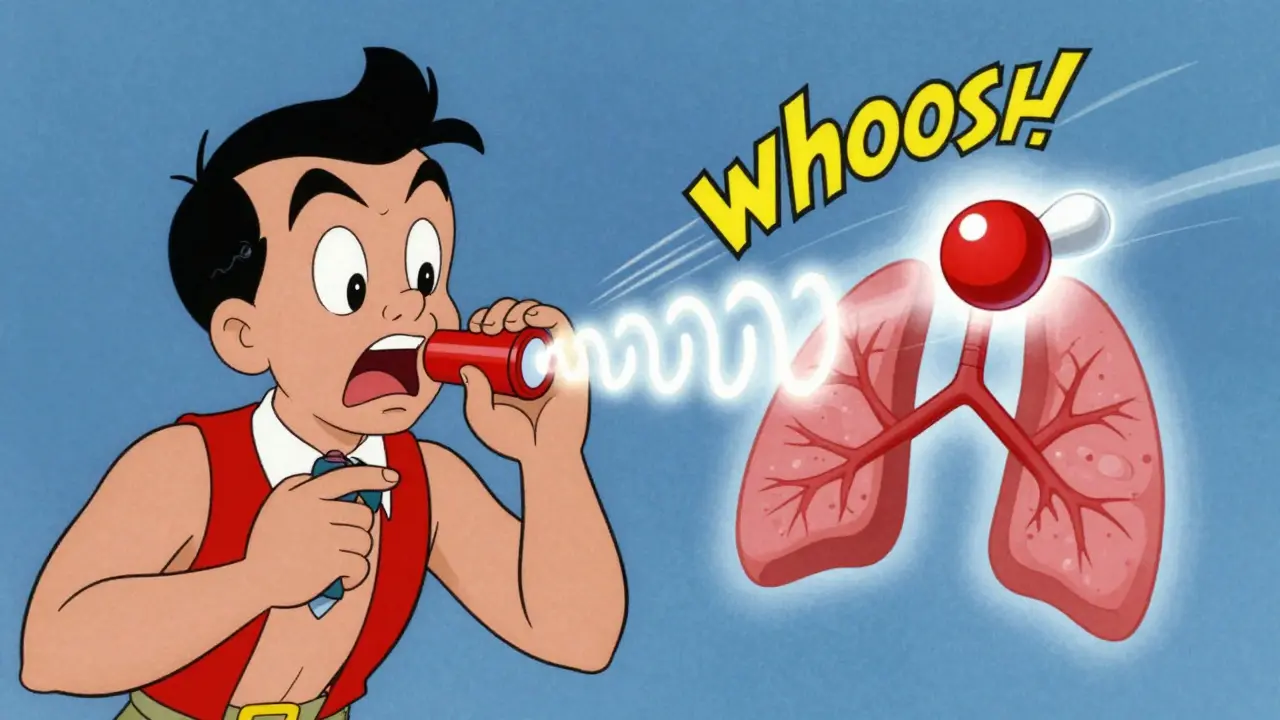
When you or someone you care about has asthma, the difference between a rescue inhaler and a maintenance inhaler isn’t just technical-it’s life or death. One gives you immediate relief when you can’t breathe. The other keeps you from needing that relief in the first place. But too many people mix them up. And that mistake can land someone in the ER-or worse.
What Rescue Inhalers Actually Do
Rescue inhalers are your emergency tool. They’re the thing you grab when your chest tightens, your breathing turns shallow, or you feel that familiar wheeze creeping in. These inhalers contain short-acting beta agonists (SABAs), most commonly albuterol (sold as Ventolin, ProAir, Proventil) or levalbuterol (Xopenex). They work fast-within 1 to 5 minutes-by relaxing the muscles around your airways. This opens them up so air can flow again.
That’s it. That’s all they do. They don’t reduce swelling. They don’t calm inflammation. They don’t fix the root problem. They just buy you time. The effect lasts about 4 to 6 hours. If you’re using your rescue inhaler more than twice a week, your asthma isn’t under control. That’s not normal. That’s a warning sign.
Studies show albuterol improves peak airflow by 85% within 10 minutes during an attack. Maintenance inhalers? They barely move the needle-only about 15% improvement. That’s why rescue inhalers are irreplaceable in emergencies. But relying on them alone is like putting tape over a leak instead of fixing the pipe.
What Maintenance Inhalers Actually Do
Maintenance inhalers are the quiet heroes. You don’t notice them when they’re working. But when you skip them, you feel it. These are daily medications designed to reduce inflammation in your airways over time. Most contain inhaled corticosteroids (ICS) like fluticasone or budesonide. Some combine these with long-acting beta agonists (LABAs) like formoterol or salmeterol.
Unlike rescue inhalers, maintenance inhalers take time. You won’t feel better right away. It takes 24 to 48 hours for the anti-inflammatory effect to start. Full benefit? That takes 1 to 3 weeks of consistent daily use. Missing even a few doses weakens the effect. One study found that skipping just 20% of your scheduled doses-say, 3 out of 15 per week-cuts effectiveness by 45%.
But the payoff is huge. A 2022 Cochrane Review of over 15,000 people showed that consistent use of maintenance inhalers reduces asthma attacks by 40% to 60%. That’s not a small win. That’s a game-changer. People who use them properly often need their rescue inhaler less than once a week.
Why Mixing Them Up Is Dangerous
Here’s the scary part: people confuse these two types all the time. Both are handheld, often look similar, and are stored together. In one documented case, a 9-year-old at summer camp grabbed his Symbicort (a maintenance inhaler) during an asthma attack because it was red-just like his rescue inhaler. He waited 12 minutes for relief. His condition worsened. He ended up in the hospital.
Symbicort contains both budesonide (a steroid) and formoterol (a long-acting bronchodilator). It’s designed for daily use. But formoterol can act as a rescue medication in certain protocols-only if the inhaler is specifically approved for that use. Most people don’t know that. They think, “It’s an inhaler, it must work now.” It doesn’t. Not reliably. And delaying the right treatment can be deadly.
The American College of Allergy, Asthma & Immunology found that 38% of near-fatal asthma cases involved people using rescue inhalers too often because they weren’t on maintenance therapy. On the flip side, some people are overprescribed maintenance inhalers. A 2022 European Respiratory Society study showed 27% of mild asthma patients were taking daily steroids when they didn’t need them-wasting money and risking side effects like oral thrush or bone thinning.

How to Tell Them Apart
Color coding helps. While not universal, most manufacturers follow this pattern:
- Red = Rescue (albuterol, levalbuterol)
- Blue = Maintenance (fluticasone, budesonide)
- Green or Purple = Combination (like Symbicort or Advair)
But don’t rely on color alone. Always check the label. Look for the active ingredient. If it says “albuterol” or “levalbuterol,” it’s a rescue inhaler. If it says “fluticasone,” “budesonide,” “mometasone,” or “ciclesonide,” it’s a maintenance inhaler. If it has two names-like “budesonide/formoterol”-it’s a combination, and you need to know whether it’s approved for as-needed use.
Storage matters too. Rescue inhalers usually last 12 months after opening. Maintenance inhalers vary-some expire after 3 months, others after 6. Keep them below 86°F (30°C). Heat weakens the medication. And never shake a dry powder inhaler like a spray-it ruins the dose.
Proper Technique Makes All the Difference
Using an inhaler wrong means you’re getting less than half the medicine. For rescue inhalers, you need to:
- Shake well
- Breathe out fully
- Place mouthpiece in mouth, seal lips
- Inhale slowly for 5 to 7 seconds
- Hold your breath for 10 seconds
- Breathe out slowly
Do this right, and you get 30-40% of the medicine into your lungs. Do it sloppy? You’re lucky to get 10-15%. That’s like taking a full dose of Tylenol and only absorbing half a pill.
Maintenance inhalers need even more discipline. You can’t skip doses because you “feel fine.” Inflammation doesn’t care how you feel. It’s still there. The American Lung Association recommends tracking rescue inhaler use. If you’re using it more than twice a week, your maintenance plan needs adjusting. Talk to your doctor.
The New Way: Single Inhaler Therapy
Things are changing. The 2023 Global Initiative for Asthma (GINA) guidelines now recommend a single-inhaler approach for many patients. Instead of two devices-one for daily use, one for emergencies-you use one inhaler for both. Symbicort (budesonide + formoterol) is approved for this. You take it daily as maintenance, and if you have symptoms, you use it as rescue.
This cuts confusion. Fewer devices. Fewer mistakes. A 2024 pilot program found this method reduced emergency visits by 30% and improved adherence by 52%. By 2027, experts predict 60% of new asthma patients will start with this single-inhalber plan.
But it’s not for everyone. If you have severe asthma, you may still need two. If you’re using a different combination inhaler (like Advair), it’s not approved for rescue use. Always check with your provider.
Cost and Access Are Real Barriers
Let’s be honest: cost keeps people from taking their maintenance inhaler. Generic albuterol rescue inhalers cost $35-$50 without insurance. But Symbicort? $300-$350 a month. That’s a lot. A 2024 Kaiser Family Foundation survey found 42% of asthma patients skipped doses because of cost.
Insurance doesn’t always help. Some plans require prior authorization. Others have high copays. If you can’t afford your maintenance inhaler, talk to your doctor. There are patient assistance programs. Generic versions are coming. And some clinics offer free samples.
Don’t let price decide your health. Skipping maintenance inhalers doesn’t save money-it increases ER visits, hospital stays, and missed work. The real cost is your breathing.
What You Should Do Today
- Check your inhalers. Are you using the right one for the right reason?
- Write down the active ingredient on each. Albuterol? Rescue. Fluticasone? Maintenance.
- Track how often you use your rescue inhaler. More than twice a week? Call your doctor.
- If you’re on a combination inhaler, ask: Is it approved for as-needed use?
- Ask about generic options or patient assistance programs if cost is an issue.
Asthma doesn’t have to control your life. But you have to control your inhalers. Rescue inhalers are for emergencies. Maintenance inhalers are for prevention. They’re not interchangeable. And understanding the difference might just save your life-or someone else’s.


Anil bhardwaj
Man, I wish I knew all this when I was 16. My dad used to use his blue inhaler during attacks because he thought it was the "stronger" one. Took him three ER trips and a near-death scare to finally get it straight. Now he uses the red one right away and the blue every day like clockwork. No more panic.
lela izzani
This is such a clear breakdown. I work in a clinic and see this confusion all the time. People think if they feel okay, they can skip maintenance. But inflammation doesn't take a day off. Consistency is everything. Also, the color coding tip? Lifesaver. Always check the label though-some generics don't follow the rules.
Nerina Devi
In India, we have a huge problem with people buying inhalers off the street because they're cheaper. No prescription, no guidance. I saw a girl in Delhi using her mom's steroid inhaler as rescue because she didn't know the difference. She almost didn't make it to the hospital. Education needs to hit the streets, not just clinics.
Vanessa Drummond
I can't believe people still don't know this. I had a coworker who used her Symbicort as her only inhaler and thought it was fine. Then she had a near-fatal attack. Turns out she didn't know formoterol isn't meant to be your first-line rescue unless you're on the single-inhaler protocol. She's lucky she's alive. Stop guessing. Ask your doctor.
Shalini Gautam
I'm from India and let me tell you-our healthcare system is a joke. People don't even know what a maintenance inhaler is. My cousin's kid was using albuterol 5 times a day because they couldn't afford the "expensive blue one." No one told them about generic fluticasone or patient programs. This isn't just ignorance-it's negligence. Why aren't we fixing this?
Steven Pam
I used to be one of those people who only used my rescue inhaler when I felt like crap. Then I started tracking my usage. I was hitting it 3-4 times a week. My doctor didn't even bring it up until I showed him the log. We switched me to a maintenance plan. Now I use my rescue maybe once a month. Best decision I ever made. Don't wait until you're gasping.
Timothy Haroutunian
Okay, so let me get this straight. You're telling me that a $300 inhaler is somehow better than a $40 one? And that the difference is 'inflammation'? I've had asthma since I was 8. I've used albuterol my whole life. I've never had an ER visit. Meanwhile, people on maintenance inhalers are still wheezing. Maybe the whole system is built on fear and profit. Maybe the real problem is overmedication. Maybe we're being sold a bill of goods.
Erin Pinheiro
I think this whole thing is a scam. I read somewhere that the pharma companies made up the whole "maintenance" thing to sell more drugs. My cousin's asthma got better when she stopped taking her inhaler. She just started drinking ginger tea and doing yoga. She hasn't used her rescue in 8 months. Coincidence? I think not.
Brandice Valentino
Honestly, I'm just shocked that people still don't know this. Like, is this 2010? I mean, I learned this in high school health class. And now I'm reading this like it's some groundbreaking revelation? I feel like I'm in a parallel universe. Maybe we need a national campaign. Or maybe just stop letting people breathe.
Larry Zerpa
You're missing the bigger picture. The 40-60% reduction in attacks? That’s based on self-reported data. People lie about adherence. And the 38% of near-fatal cases? That doesn’t account for the fact that most of those patients were noncompliant for years. The real issue is systemic failure, not inhaler confusion. Also, single-inhaler therapy? That’s just another way to lock patients into branded drugs. Generic albuterol has been proven safe for 40 years. Why are we abandoning it?
Gwen Vincent
I appreciate how thorough this is. I’ve been using my inhalers for 15 years and never knew about the 10-second hold. I always just inhaled and exhaled. I feel like such an idiot. But now I’m doing it right. My lung function test improved 20% last year. Small changes matter. Thank you for the clarity.
Nandini Wagh
Funny how we call them 'rescue' and 'maintenance' like they're superheroes. Meanwhile, people in rural India are using expired inhalers they bought from roadside vendors. The real crisis isn't confusion-it's poverty. But hey, at least we know the colors now.
Holley T
I’m not convinced by the single-inhaler approach. Formoterol is a LABA. LABAs alone increase the risk of severe asthma events. The FDA black box warning is there for a reason. Combining it with a steroid doesn’t erase that. The GINA guidelines are pushing this because they’re funded by AstraZeneca. This isn’t science-it’s corporate strategy. I’ve seen too many patients get sicker after switching. Don’t be a guinea pig.
Ashley Johnson
I know someone who died because they used the wrong inhaler. It was her daughter. She was 11. She grabbed the blue one because it looked like the one her mom used. Took 15 minutes to get relief. She never made it to the hospital. Now I check every inhaler in my house like it's a bomb. Color coding? Doesn't matter. Label reading? That's the only thing that saves lives.