
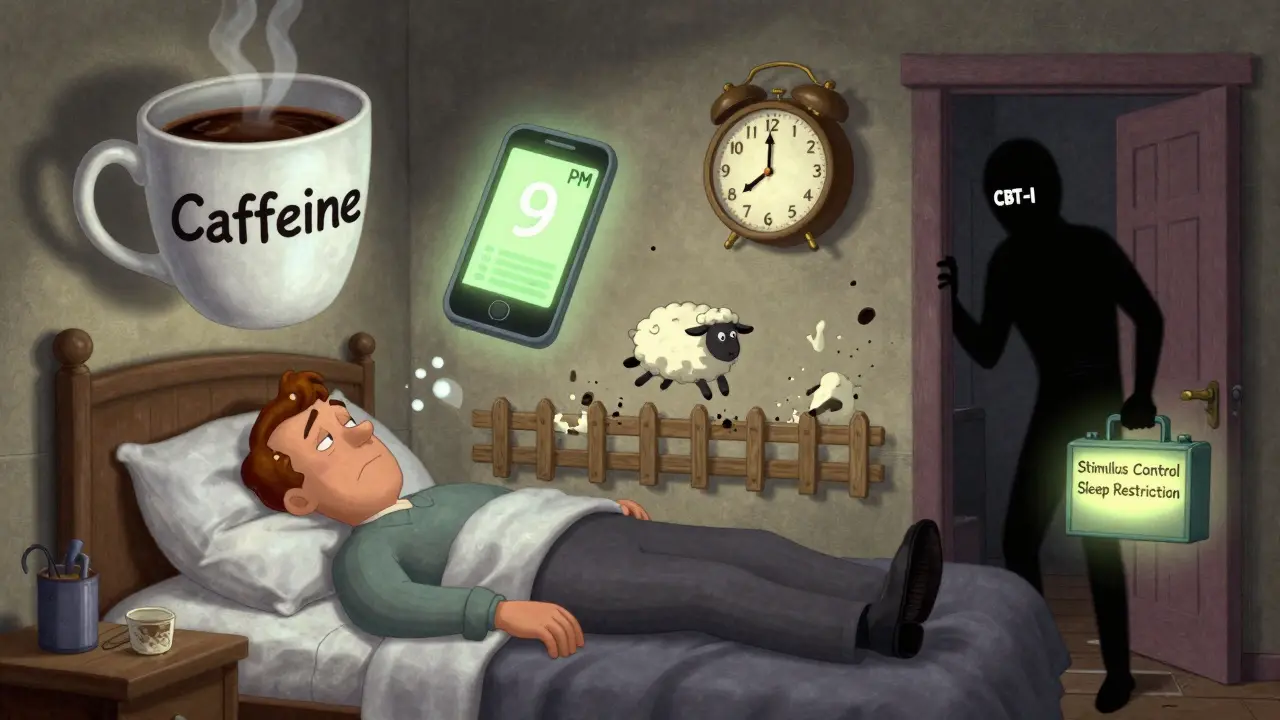
If you’ve been lying awake for hours night after night, counting sheep, drinking chamomile tea, and turning off your phone at 9 p.m., you’re not alone-and you’re also not doing enough. Chronic insomnia isn’t just a bad night’s sleep. It’s a medical condition that lasts at least three months, happens at least three nights a week, and leaves you exhausted, irritable, and stuck in a cycle of fear about sleep. The truth? Simple sleep hygiene tips like avoiding caffeine or keeping your room dark won’t fix it. What actually works? A proven, science-backed approach called Cognitive Behavioral Therapy for Insomnia (CBT-I). And yes, it’s more effective than sleeping pills-without the side effects, dependence, or rebound insomnia.
What Chronic Insomnia Really Means
Chronic insomnia isn’t about stress or a busy schedule. It’s when your brain and body get stuck in a pattern of poor sleep that doesn’t go away, even when the original cause (like job loss, illness, or travel) is long gone. The American Academy of Sleep Medicine defines it clearly: difficulty falling asleep, staying asleep, or waking up too early-plus daytime problems like fatigue, trouble concentrating, or mood swings-happening at least three nights a week for three months or more.
Most people think their insomnia is caused by too much screen time or coffee. But research shows it’s usually a mix of three things: predisposing factors (like being naturally a light sleeper), precipitating factors (like a stressful event), and perpetuating factors (the habits you develop to cope). That last one is the trap. You start napping to make up for lost sleep. You lie in bed watching TV to relax. You check the clock every 10 minutes. These behaviors, meant to help, actually make insomnia worse.
Why Sleep Hygiene Isn’t Enough
You’ve heard the advice: no caffeine after 2 p.m., no screens before bed, keep your room cool, avoid alcohol. These are called sleep hygiene tips. They sound logical. But here’s the problem-they don’t fix chronic insomnia.
A 2023 review from the National Institutes of Health found sleep hygiene alone has only moderate evidence of effectiveness. In fact, leading experts like Dr. Jack D. Edinger say it’s minimally effective as a standalone treatment. Why? Because it treats symptoms, not the root cause. If you’ve been lying awake for hours for months, your brain has learned to associate your bed with wakefulness. No amount of lavender oil or white noise will undo that.
One Reddit user summed it up: “I did everything right-no coffee, no alcohol, dark room, 68°F, meditation. Still woke up at 3 a.m. every night. Felt like I was failing.” That’s because sleep hygiene doesn’t retrain your brain. It’s like putting a bandage on a broken bone.
Cognitive Behavioral Therapy for Insomnia (CBT-I): The Gold Standard
CBT-I isn’t just another therapy. It’s the first-line treatment for chronic insomnia, backed by over 20 years of research and endorsed by the American College of Physicians, the American Academy of Sleep Medicine, and the World Health Organization. Unlike pills, it doesn’t mask symptoms-it rewires the way you think and behave around sleep.
CBT-I is typically delivered over 6 to 8 weekly sessions with a trained therapist. But even shorter versions-like two intensive sessions-can help. It’s not about relaxation techniques or hypnosis. It’s about behavior change, based on five core components:
- Stimulus Control: Your bed is for sleep and sex only. If you’re not asleep within 15-20 minutes, get up. Go to another room. Do something quiet and boring-read a book under dim light. Don’t check your phone. Return to bed only when sleepy. Repeat. This breaks the association between bed and wakefulness.
- Sleep Restriction: This sounds crazy, but it works. You limit the time you spend in bed to match how much you’re actually sleeping. If you only sleep 5 hours a night, you’re only allowed in bed for 5 hours. That means going to bed later and waking up earlier. It sounds brutal, and yes, you’ll feel tired at first. But by increasing your sleep drive, your body starts consolidating sleep into one solid block. Within weeks, you’ll gradually add back time in bed as efficiency improves.
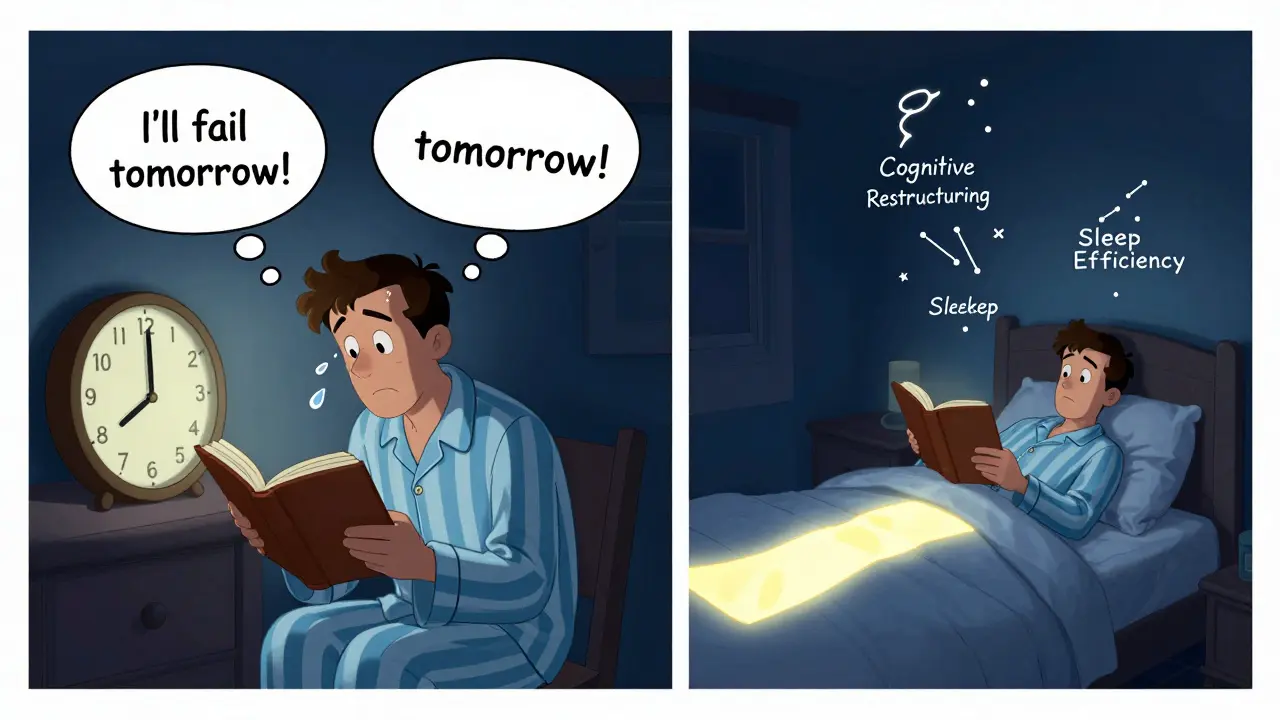
- Cognitive Restructuring: You’re probably telling yourself things like, “I need 8 hours or I’ll crash at work,” or “If I don’t sleep tonight, tomorrow will be a disaster.” These thoughts create anxiety-and anxiety keeps you awake. CBT-I helps you challenge these beliefs. Studies show 65% of patients see a drop in sleep-related anxiety after this component.
- Relaxation Training: Not just deep breathing. Techniques like progressive muscle relaxation, diaphragmatic breathing, or mindfulness help calm your nervous system so your body can shift into sleep mode.
- Sleep Hygiene Education: Yes, this is included-but only as a supporting piece. It’s not the star. It’s the supporting actor.
CBT-I isn’t magic. It’s hard work. But the results? Powerful. A 2020 meta-analysis in Sleep Medicine Reviews found CBT-I reduced time to fall asleep by an average of 18.2 minutes and cut nighttime wakefulness by 27.4 minutes. And unlike sleeping pills, these improvements last-12 months later, patients still slept better.
CBT-I vs. Sleeping Pills: The Long Game
Medications like zolpidem (Ambien), eszopiclone (Lunesta), or suvorexant (Belsomra) can help in the short term. But here’s the catch: after 4 to 6 weeks, their effectiveness drops. And the risks? Dependence, memory problems, falls in older adults, and rebound insomnia when you stop.
CBT-I has no side effects. No withdrawal. No tolerance. It doesn’t just give you sleep-it gives you back control. One patient shared on a sleep forum: “After 8 weeks of CBT-I, my sleep efficiency jumped from 68% to 89%. I went from taking 2 hours to fall asleep to 15 minutes. I didn’t need pills anymore.”
And the data backs it up. A 2021 study in JAMA Internal Medicine found internet-based CBT-I programs like Sleepio and SHUTi led to 50-60% remission rates. That’s more than double the rate of placebo groups. Even better? These programs are now FDA-cleared and covered by some insurers.
Why CBT-I Is Hard to Access
If CBT-I works so well, why aren’t more people doing it? Because it’s not easy to find.
In the U.S., there are only 0.5 certified CBT-I therapists per 100,000 people. In rural areas, 78% of counties have zero sleep specialists. Insurance often covers only 3-4 sessions, even though 6-8 are recommended. One Reddit user wrote: “My insurance paid for three sessions. I had to pay $200 out of pocket for the rest. I couldn’t afford it.”
But things are changing. Digital CBT-I platforms like Somryst, Sleepio, and SHUTi are now FDA-cleared as prescription digital therapeutics. They use the same protocols as in-person therapy-just delivered through an app. A 2020 FDA submission showed Somryst achieved 55.4% remission rates. And 37% of Fortune 500 companies now offer CBT-I through employee wellness programs.
Wearables are catching up too. Fitbit’s 2022 Sleep Profile now uses your 30+ nights of sleep data to suggest personalized sleep restriction windows-essentially turning your tracker into a mini CBT-I coach.
What to Expect When You Start
CBT-I isn’t comfortable. The first two weeks are the hardest. Sleep restriction means you’ll be tired. Stimulus control means you’ll get up in the middle of the night. Cognitive restructuring means you’ll question your deepest fears about sleep.
But here’s what happens next:
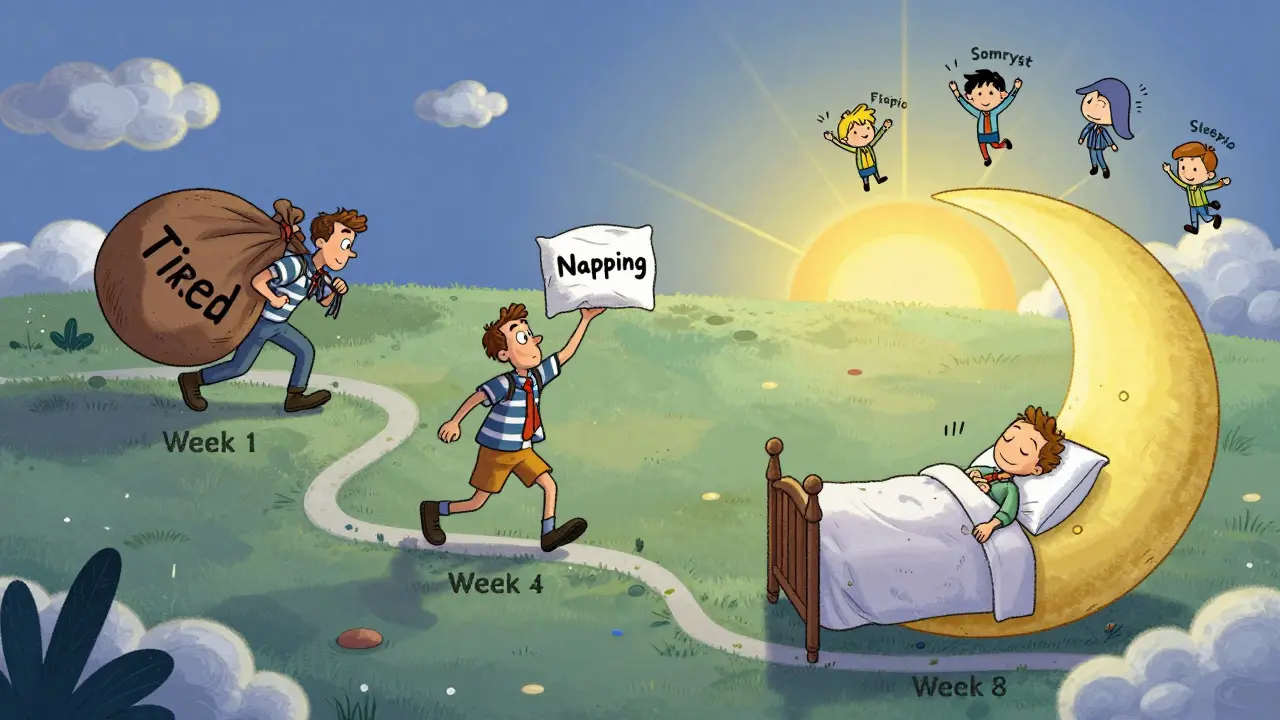
- By week 3: You notice you’re falling asleep faster-even if you’re still waking up once.
- By week 5: You stop checking the clock. You stop worrying about tomorrow.
- By week 8: You’re sleeping 6-7 hours without effort. And you’re not dreading bedtime.
One study found 78% of users reported reduced daytime fatigue after completing CBT-I. That’s not just better sleep-that’s better work, better mood, better life.
Real-World Tips to Get Started
You don’t need a therapist to begin. Start here:
- Track your sleep for 7-14 days. Note when you get in bed, when you fall asleep, when you wake up, and how many times you wake up. This is your baseline.
- Calculate your sleep efficiency: (Total sleep time ÷ Time in bed) × 100. If it’s 70%, your initial time in bed should be 70% of your total time in bed. Example: If you’re in bed 8 hours and sleep 5.6 hours, start with 5.5 hours in bed.
- Set a fixed wake time. No exceptions. Even on weekends. This is the anchor.
- Get out of bed if awake for 15-20 minutes. Don’t lie there stressing. Go read. Sit quietly. Don’t use your phone.
- Eliminate caffeine after 2 p.m. (AASM recommends 6 hours before bed). No chocolate, tea, or energy drinks.
- Stop alcohol 4 hours before bed. It may help you fall asleep, but it destroys sleep quality after midnight.
- Keep your bedroom at 65°F (18.3°C). That’s the sweet spot for sleep, according to the Sleep Foundation.
Don’t try to do everything at once. Pick one or two steps. Stick with them. Then add more.
Who Should Avoid CBT-I?
CBT-I is safe for almost everyone-older adults, shift workers, people with chronic pain, even perimenopausal women. The American Academy of Sleep Medicine updated its 2023 guidelines to recommend CBT-I for all adult populations.
The only exceptions? People with untreated sleep apnea, severe depression with suicidal risk, or psychosis. If you’re on long-term benzodiazepines, you’ll need to work with a doctor to taper before starting CBT-I.
The Future of Insomnia Treatment
The market for digital CBT-I is projected to hit $1.2 billion by 2027. AI-powered tools are already personalizing sessions based on your sleep data. Pear Therapeutics’ reSET-S app, currently in Phase 3 trials, shows 63% response rates at 12 weeks.
Dr. Andrew Krystal, a leading sleep expert at the University of California, predicts: “CBT-I will become the standard of care for 90% of chronic insomnia cases within the next decade.”
That means sleeping pills will be reserved for short-term use-like after surgery or during acute stress. Not for lifelong dependency.
Final Thought: Sleep Isn’t a Problem to Fix. It’s a Habit to Rebuild.
Chronic insomnia isn’t your fault. But fixing it isn’t about finding the right pill. It’s about undoing the habits your brain learned over months or years. CBT-I doesn’t force sleep. It teaches your body how to return to it naturally. And once you do, you won’t just sleep better-you’ll feel more like yourself again.
Is sleep hygiene enough for chronic insomnia?
No. While sleep hygiene-like avoiding caffeine or keeping your room dark-is helpful, it’s not enough on its own for chronic insomnia. Experts like Dr. Jack D. Edinger and the American Academy of Sleep Medicine state that sleep hygiene alone has only moderate evidence of effectiveness and should never be used as the primary treatment. Chronic insomnia requires behavior change, which is what CBT-I delivers.
How long does CBT-I take to work?
Most people start noticing improvements in 2-4 weeks, especially with sleep restriction and stimulus control. Full benefits-like falling asleep faster and staying asleep longer-usually take 6-8 weeks. Some report major changes after just two intensive sessions, but consistency matters more than speed. The effects last long after treatment ends.
Can I do CBT-I without a therapist?
Yes. Several FDA-cleared digital programs like Sleepio, SHUTi, and Somryst deliver full CBT-I protocols through apps. Studies show these programs achieve 50-60% remission rates, similar to in-person therapy. They include sleep tracking, daily exercises, and personalized feedback. They’re especially helpful if therapists aren’t available in your area.
Why is sleep restriction so hard?
Sleep restriction works by increasing your sleep drive through mild sleep deprivation. That means you’ll feel exhausted for the first 1-2 weeks. It’s uncomfortable, even scary. But research shows 62% of users report this phase as the toughest-and also the most transformative. Your body adapts, and soon you’re sleeping more efficiently in less time. The fatigue passes. The sleep doesn’t.
Does CBT-I work for older adults?
Yes. Dr. Daniel Buysse’s research shows CBT-I produces large clinical improvements in older adults, with effect sizes of 1.0-1.3 on the Insomnia Severity Index. It’s safer than sleeping pills for seniors, who are at higher risk for falls, memory issues, and drug interactions. The American Academy of Sleep Medicine recommends CBT-I as first-line treatment for all adults, including those over 65.
What’s the Insomnia Severity Index (ISI)?
The ISI is a 7-question tool used by clinicians to measure how severe insomnia is. Scores range from 0-28. A score of 15-21 means moderate insomnia; 22-28 means severe. It helps track progress during CBT-I. Many digital programs now include a built-in ISI tracker so you can see your improvement over time.

Byron Duvall
Let me guess - you're one of those people who thinks CBT-I is some kind of corporate mind-control scheme disguised as therapy. I've seen the ads. The apps. The 'FDA-cleared' stamp. Sounds like Big Sleep is trying to sell us a $200/month subscription to stop thinking about our problems. Meanwhile, my cousin took Ambien for two weeks and slept like a baby. No apps. No journaling. Just a little white pill. Why are we overcomplicating this? They make sleeping pills because they work. Not because they're evil.
Katherine Farmer
Oh, please. You're treating insomnia like it's a glitch in a poorly coded app that can be patched with a few behavioral updates. The truth? Sleep is a neurochemical symphony, not a habit you can retrain like brushing your teeth. CBT-I is a band-aid on a hemorrhage. The real issue is circadian disruption from blue light, electromagnetic pollution, and the fact that modern life has turned our nervous systems into overstimulated jackhammers. You can't 'restructure cognitions' when your adrenal glands are permanently stuck on 'fight or flight.' And don't get me started on how pharmaceutical companies have quietly buried the real research on melatonin receptor agonists. This is capitalism masquerading as science.
Full Scale Webmaster
I’ve been doing CBT-I for 11 weeks now. I’m not here to sell you anything. I’m here because I was the guy who cried in the bathroom at 3 a.m. for 18 months straight. I did everything. Lavender oil. Weighted blankets. White noise machines. Binaural beats. I even tried hypnosis on YouTube. Nothing. Then I started sleep restriction. I went from 6 hours in bed to 4.5. I was a zombie. My boss thought I was high. My cat started avoiding me. But here’s the thing - by week 5, I stopped checking the clock. I didn’t even notice. Then, one night, I woke up at 7 a.m. without an alarm. No caffeine. No pills. Just… sleep. It wasn’t magic. It was brutal. And it worked. If you’re still scrolling through Reddit instead of getting up at 6 a.m. like your sleep efficiency demands - you’re not ready. And that’s okay. But don’t blame the therapy. Blame yourself for not being willing to suffer for six weeks to get eight hours of peace.
Brandie Bradshaw
CBT-I is the only thing that ever worked for me after 12 years of insomnia. I used to think I was broken. Turns out I just had a brain that learned to associate my bed with panic. The stimulus control part? Terrifying. Getting up every time I wasn’t asleep felt like betrayal. But here’s what no one tells you: the fatigue doesn’t kill you. The fear does. And once you stop fearing sleep - it comes back. Not perfectly. Not instantly. But it comes. And when it does, you realize you weren’t broken. You were conditioned. And conditioning can be undone. It’s not about willpower. It’s about reprogramming. And yes, it’s harder than popping a pill. But you’re not losing sleep. You’re reclaiming your life.
Angel Wolfe
CBT I is just the government's way of making us pay for sleep instead of giving it to us free like in the 90s now they want us to buy apps and track our REM cycles like some kind of data slave i used to sleep 8 hours just by closing my eyes now i need a subscription and a smart mattress and a therapist who charges 200 an hour what happened to america
Sophia Rafiq
Just wanted to say I started sleep restriction last week. Been in bed for 5.5 hours. Woke up at 5:30 a.m. on the dot. Felt like death. But I didn’t check my phone. Didn’t nap. Just drank water and walked. And last night? Fell asleep in 12 minutes. No meds. No apps. Just discipline. I’m not saying it’s easy. But it’s possible. And honestly? It’s kind of beautiful to realize your body knows how to sleep - you just got in its way.
Eimear Gilroy
Interesting how the post frames CBT-I as the 'gold standard' without acknowledging how deeply inaccessible it remains for most people. In Ireland, there’s a six-month waitlist for a single sleep clinic appointment. And digital CBT-I platforms? They’re often locked behind employer wellness programs or require credit card details. Meanwhile, the NHS spends millions on sleeping pills every year. It’s not that CBT-I doesn’t work - it’s that we’ve built a system that profits from people being tired. The real solution isn’t therapy. It’s systemic: better work hours, less screen time in public spaces, mandatory sleep education in schools. Until then, we’re just rearranging deck chairs on the Titanic.
Ajay Krishna
I’ve been helping my uncle through CBT-I. He’s 72, has chronic back pain, and never believed sleep could be 'fixed.' But he did the sleep restriction. He stuck to the fixed wake time. He stopped napping. And now? He sleeps 6.5 hours. No pills. No anxiety. He says it felt like waking up from a long dream he didn’t know he was in. I think the biggest myth is that this is only for young people or 'high-functioning' folks. It works for everyone - if they’re willing to be patient. And honestly? The most powerful part isn’t the technique. It’s the quiet dignity that comes from taking back your own rest.