
H2 Blocker & Antifungal/Antiviral Interaction Checker
Check if your H2 blocker is safe to take with your antifungal or antiviral medication. The tool analyzes interactions based on clinical evidence from the article.
Note: Always consult your healthcare provider before making changes to your medication regimen.
When you take an H2 blocker like famotidine or cimetidine for heartburn or ulcers, you might not think twice about it. But if you're also on an antiviral or antifungal drug, this common medication could be quietly sabotaging your treatment. The problem isn't rare or theoretical - it's happening in real clinics, hospitals, and homes every day. And most people don't even know it's happening.
What H2 Blockers Really Do
H2 blockers - or histamine H2-receptor antagonists - work by blocking the signal that tells your stomach to make acid. They don't shut it off completely like proton pump inhibitors (PPIs). Instead, they dial it down. That’s why they’re used for GERD, peptic ulcers, and dyspepsia. The effect kicks in within an hour and lasts 6 to 12 hours. Famotidine (Pepcid) is the most common today. Cimetidine (Tagamet) is still around, but rarely used because of its side effects. Ranitidine (Zantac) was pulled from the market in 2020 after it was found to contain NDMA, a probable cancer-causing chemical.
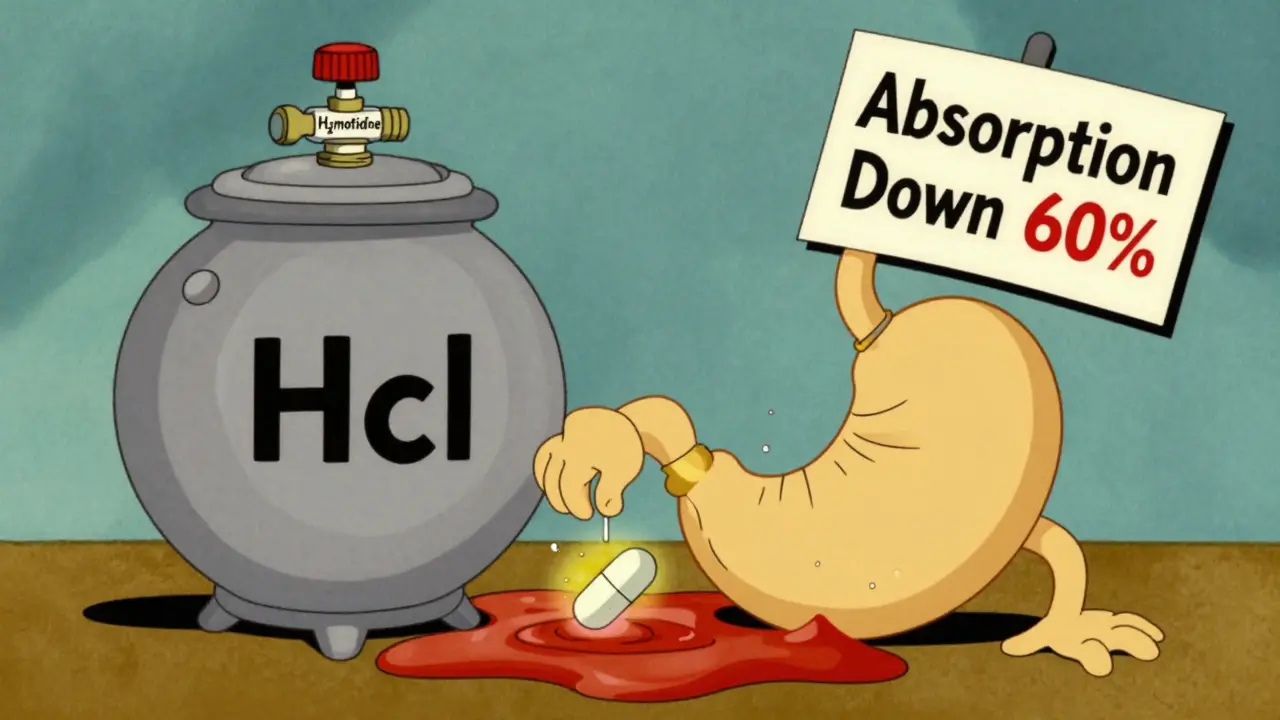
But here’s the catch: your stomach acid isn’t just there to digest food. It’s also a key player in helping certain drugs get absorbed into your bloodstream. When you reduce that acid, some medications simply can’t get into your system the way they’re supposed to. And that’s where antivirals and antifungals come in.
Why Some Antifungals Fail When Taken With H2 Blockers
Not all antifungals are the same. Some need acid to dissolve. Others don’t care. The difference can mean the difference between healing and a worsening infection.
Itraconazole is one of the biggest offenders. It’s used for fungal infections like aspergillosis and histoplasmosis. But it’s poorly soluble. Without enough stomach acid, it doesn’t dissolve. Studies show that when taken with an H2 blocker, its absorption drops by 40% to 60%. That’s not a small drop - it’s enough to let the fungus grow unchecked. The FDA and the Journal of Antimicrobial Chemotherapy both warn about this. Even worse, the tablet form is especially vulnerable. The liquid form, however, contains citric acid and can still be absorbed even with reduced stomach acidity.
Fluconazole? Not a problem. It dissolves easily in water, regardless of pH. So if you’re on fluconazole, you don’t need to worry about H2 blockers messing with it.
Then there’s voriconazole, posaconazole, and isavuconazole - all azole antifungals. Voriconazole and posaconazole are also affected by pH, though not as severely as itraconazole. Isavuconazole, on the other hand, is more forgiving. A major 2018 study in the New England Journal of Medicine found isavuconazole caused fewer drug interactions than voriconazole, with 26% fewer dose adjustments needed.
The Hidden Danger: Cimetidine and the CYP450 System
It’s not just about stomach acid. Cimetidine has another dangerous trick up its sleeve: it blocks liver enzymes.
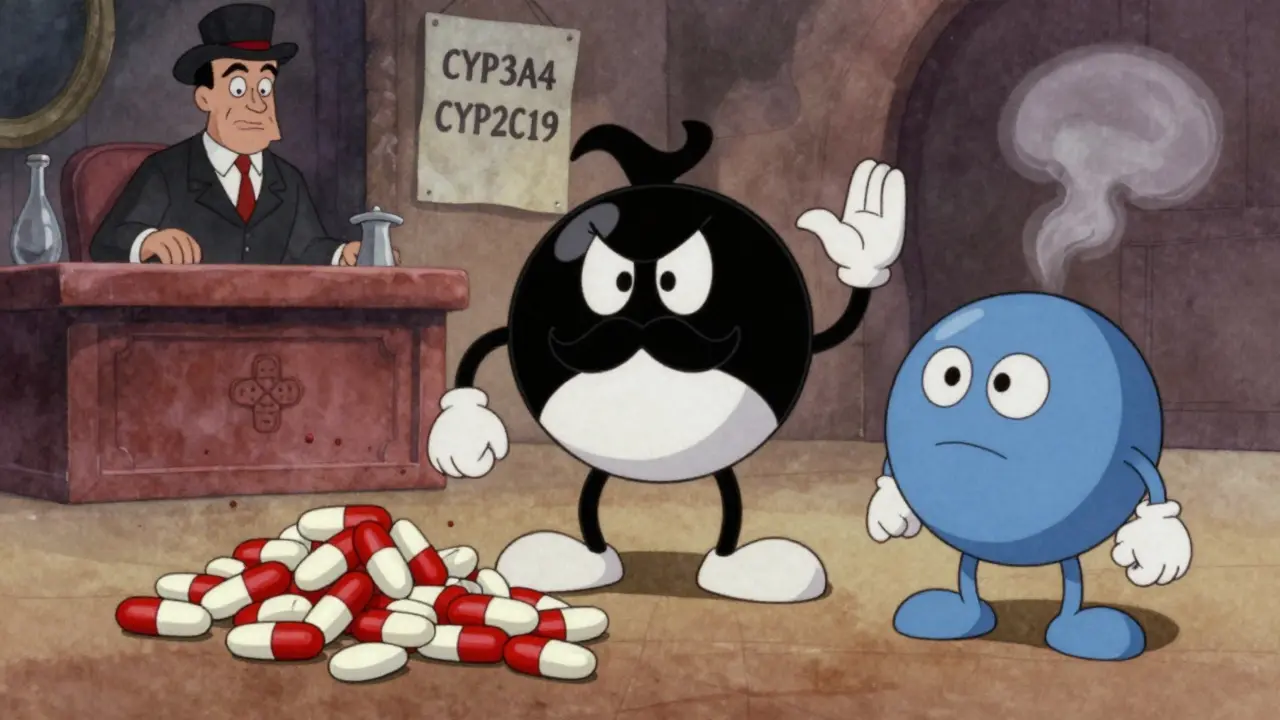
The liver uses enzymes called cytochrome P450 (CYP450) to break down drugs. Cimetidine blocks several of them - especially CYP3A4, CYP2C19, and CYP2D6. That means drugs processed by these enzymes can build up in your blood to toxic levels.
Take voriconazole. It’s broken down by CYP2C19 and CYP3A4. When you take it with cimetidine, voriconazole levels can spike by 40%. That raises your risk of side effects like hallucinations, liver damage, or skin rashes. A 2024 study in the Journal of Antimicrobial Chemotherapy found cimetidine was involved in 63% of all documented H2 blocker interactions with antifungals.
Famotidine? No such problem. It doesn’t touch those enzymes. That’s why experts now say: if you need an H2 blocker and you’re on an antifungal, go with famotidine. Avoid cimetidine entirely.
Antivirals and the pH Trap
Antivirals aren’t off the hook either. Atazanavir - an HIV drug - is one of the worst affected. It needs acid to dissolve. When taken with famotidine, studies show its absorption drops by up to 77%. That’s not just inconvenient - it’s dangerous. Lower levels of atazanavir mean the virus can start replicating again, leading to drug resistance.
The FDA reviewed 42 antiviral labels in 2022 and found 68% of them had warnings about acid-reducing drugs. That’s a huge red flag. Many of these drugs - including dasatinib, rilpivirine, and certain hepatitis C treatments - rely on stomach acid to work.
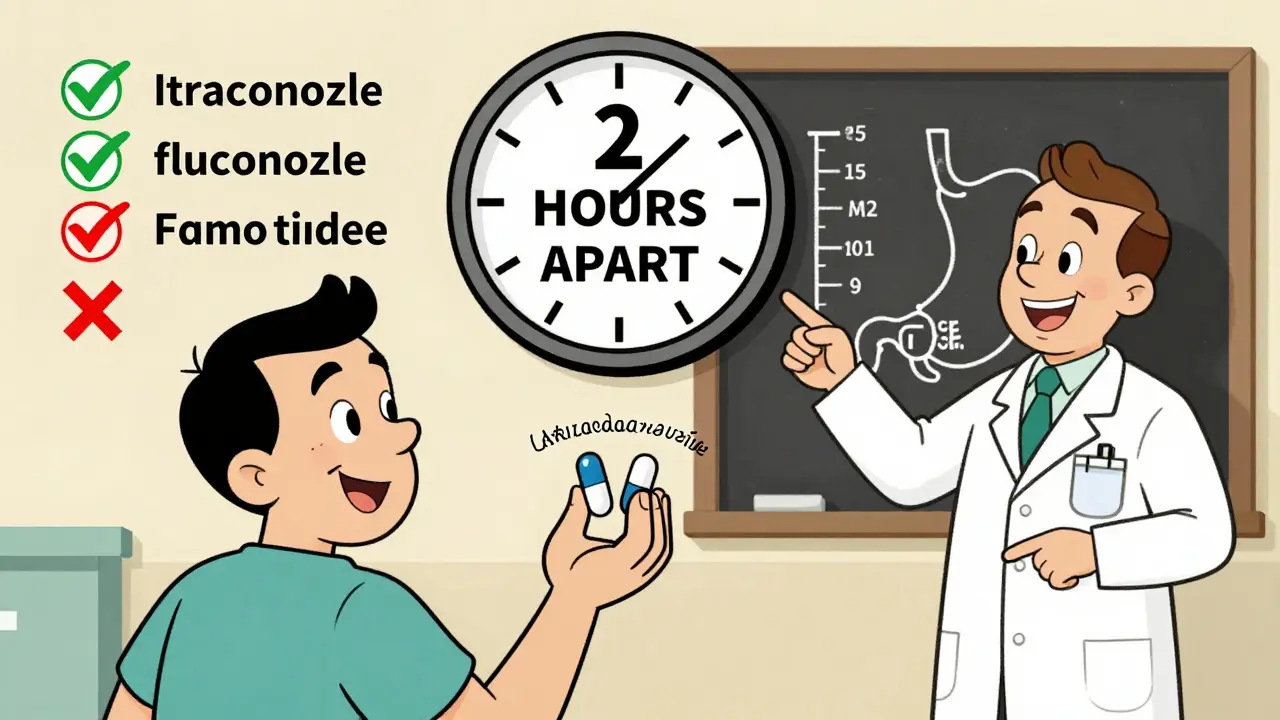
But here’s the twist: timing matters. If you take atazanavir at least 2 hours before your H2 blocker, your stomach still has enough acid to dissolve the drug. The FDA specifically recommends this timing. But how many patients actually get told this? A 2022 survey of 1,200 hospital pharmacists showed only 43% consistently gave patients clear timing instructions.
Which H2 Blocker Is Safest?
Let’s cut through the noise.
| H2 Blocker | Effect on Stomach pH | CYP450 Inhibition | Best for Use With Antifungals/Antivirals? |
|---|---|---|---|
| Cimetidine | High | Yes - blocks CYP1A2, 2C9, 2C19, 2D6 | No - highest interaction risk |
| Famotidine | High | No - minimal enzyme interference | Yes - safest choice |
| Nizatidine | High | No | Yes - safe, but less available |
Bottom line: if you must use an H2 blocker, go with famotidine. Avoid cimetidine at all costs. Nizatidine is fine too, but it’s harder to find.
How to Avoid Treatment Failure
You don’t need to stop your H2 blocker. But you do need to change how you take it.
- For itraconazole tablets: Don’t take with any H2 blocker. Use the oral solution instead if acid suppression is needed.
- For voriconazole: Monitor blood levels. If you’re on cimetidine, consider switching to famotidine or adjusting the dose.
- For atazanavir: Take it at least 2 hours before your H2 blocker. Never take them together.
- For posaconazole: Separate administration by at least 2 hours, as the FDA recommends.
- For fluconazole and isavuconazole: No special timing needed. These are safe with H2 blockers.
Also, don’t assume your doctor knows. A 2023 study found that 31% of antiviral labels didn’t even include clear timing instructions. If you’re on an antifungal or antiviral and you’re taking an H2 blocker, ask your pharmacist: "Does this interact? When should I take them?"
Why This Matters More Than You Think
In 2022, the FDA cited 17 cases of antifungal treatment failure directly linked to improper use with acid-reducing drugs. Many of these were in immunocompromised patients - people with cancer, transplants, or HIV. For them, a fungal infection isn’t just uncomfortable. It’s life-threatening.
And it’s not just about drugs. A 2023 IQVIA analysis showed prescriptions for H2 blockers dropped by 18% in patients on azole antifungals between 2019 and 2022. Why? Because doctors learned the hard way. They switched to famotidine. Or they stopped using H2 blockers entirely and switched to PPIs with careful timing. Or they used alternative treatments like sucralfate.
There’s hope on the horizon. New formulations of itraconazole - lipid-based, pH-independent - are in early trials. If they work, this whole interaction problem could disappear. But until then, knowledge is your best defense.
Can I take famotidine with fluconazole?
Yes. Fluconazole doesn’t need stomach acid to be absorbed, and it doesn’t interact with famotidine’s metabolism. You can take them together without timing adjustments.
Is cimetidine ever safe to use with antivirals?
No. Cimetidine strongly inhibits liver enzymes that break down many antivirals and antifungals. It can cause dangerous drug buildup. Avoid it completely if you’re on any antiviral or azole antifungal.
What should I do if I’m on atazanavir and need heartburn relief?
Take atazanavir at least 2 hours before your H2 blocker. If you’re on famotidine, that’s usually enough. Avoid PPIs unless absolutely necessary - they suppress acid longer, making timing harder.
Do H2 blockers affect all antifungals the same way?
No. Itraconazole is highly affected. Fluconazole isn’t. Voriconazole and posaconazole are moderately affected. Isavuconazole is the least affected. Always check the specific drug you’re taking.
Why did ranitidine get pulled from the market?
Ranitidine was found to contain NDMA, a chemical linked to cancer. The FDA confirmed levels exceeded safe limits during storage and manufacturing. It was withdrawn in 2020 in the U.S., Australia, and Europe.
What Comes Next
Doctors and pharmacists are slowly catching on. The American Society of Health-System Pharmacists now recommends famotidine over PPIs when acid suppression is needed with antifungals - because its effects wear off faster. That gives you a window to take your antifungal in a more acidic environment.
But the real solution? Better labeling. The FDA is reviewing rules to require all pH-dependent drugs to include clear timing instructions. If passed, it could cut interaction-related failures by 35%.
For now, if you’re on an antiviral or antifungal, don’t just assume your heartburn medicine is safe. Ask. Check. Time it. Your treatment depends on it.



Kal Lambert
Famotidine with fluconazole? No problem. I've seen this mix in transplant patients for years. Just make sure they're not taking it with itraconazole tablets. Liquid itraconazole + famotidine? Fine. But never together with cimetidine. Ever. Simple as that.
Aileen Nasywa Shabira
Oh wow, so now we're blaming H2 blockers for every failed fungal infection? Let me guess-next you'll say sunlight causes cancer because it's 'too bright.'
My aunt took cimetidine for 12 years with voriconazole and she's still alive, thriving, and laughing at 'clinical studies.' Maybe your patients just suck at taking meds? Or maybe the real issue is that doctors don't bother to TALK to people?
Also, why is famotidine suddenly the golden child? It's just a cheaper Zantac with a new name. Don't act like it's some miracle drug.
Linda Olsson
I’ve been researching this for months. The FDA doesn’t tell you the whole truth. They’re pressured by Big Pharma to push famotidine because it’s patent-free and they want you to keep buying it. Meanwhile, cimetidine is being quietly demonized because it’s old, cheap, and interferes with their new $1,200 antifungal regimens.
Did you know cimetidine was originally developed as an anti-ulcer drug in the 70s? It’s been used safely by millions. Now it’s a villain because it ‘inhibits enzymes’? Every herb, every tea, every coffee inhibits enzymes. But you don’t see them banning green tea, do you?
And don’t get me started on the NDMA panic with ranitidine. That chemical is in grilled meat, smoked fish, and your tap water. But hey, let’s pull a $2 drug off the market and replace it with a $40 one. Classic.
Amadi Kenneth
I'm from Nigeria, and I can tell you-this whole 'pH-dependent absorption' thing is a myth invented by Western doctors who've never seen a real patient with no access to labs. In Lagos, we give itraconazole tablets with famotidine every day. The patient gets better. Why? Because their body doesn't care about your pH charts. It adapts. You're overcomplicating medicine.
Also, who are you to say 'avoid cimetidine at all costs'? My uncle took it with HIV meds for 8 years. He's alive. Your 'studies' don't reflect real life. Stop scaring people with data from hospitals in Boston.
Melissa Starks
I just want to say thank you for writing this. I’m a nurse in a rural clinic, and I’ve seen so many patients come in with fungal infections that just wouldn’t clear-because their doctor didn’t know about this interaction. One woman was on itraconazole for thrush and took Pepcid every night for acid reflux. Her infection got worse for six months. We switched her to fluconazole and told her to take Pepcid 2 hours after her antifungal. Boom. Gone in 10 days.
And yes, doctors don’t tell patients this. Pharmacists don’t either. I had to Google it myself. So thank you for making this clear. I’m printing this out and laminating it for our med cart. We need more of this-no jargon, no fluff, just facts. Also, I’m telling my boss we need to update our med reconciliation forms. This is critical.
Manish Singh
This is why I love reading thoughtful medical content. You don’t just list facts-you explain why they matter. I’m from India, and we have a huge problem with self-medication. People buy cimetidine over the counter, take it with antifungals, and then blame the drug when it doesn’t work.
I’ve had patients tell me, 'My cousin took this with that and got better.' But cousins aren’t clinical trials. I’ve started handing out laminated cards in our clinic: 'If you’re on antifungal or antiviral, ask: Is it acid-dependent? What’s my H2 blocker? When should I take them?'
Small changes. Big impact. Thank you for giving us something we can actually use.
Lauren Volpi
So let me get this straight-your solution to a $2 drug interaction is to switch to another $2 drug? That’s it? No new science? No breakthrough? Just ‘use famotidine instead’? Wow. Groundbreaking. I’m sure the FDA is thrilled.
Meanwhile, people in Africa and South Asia are dying because they can’t even get famotidine. But hey, at least we got our fancy guidelines. Progress.
Shameer Ahammad
The scientific rigor displayed in this post is commendable, yet it remains insufficiently contextualized. One must consider the ontological framework of pharmacokinetics in relation to socio-economic determinants of health. The assertion that famotidine is ‘safest’ presumes a level of healthcare access that is non-universal. In low-resource settings, the distinction between H2 blockers is irrelevant when access to any medication is sporadic. Furthermore, the reliance on Western clinical guidelines as normative is a form of epistemic colonialism. The data is sound-but the application is ethically fraught.
Ayan Khan
There’s a quiet dignity in how the body adapts. We focus so much on chemistry-pH, enzymes, absorption-that we forget medicine is also about rhythm, timing, and human behavior.
One patient I knew took his atazanavir at 7 a.m. and his famotidine at 10 p.m. No one told him to separate them. He just did it instinctively. He felt better. His viral load stayed undetectable for 11 years.
Maybe the answer isn’t just in the drug labels. Maybe it’s in listening-to patients, to traditions, to the way people actually live. We’ve turned medicine into a spreadsheet. But healing? Healing is messy. It’s human.
Alexander Pitt
Key takeaway: If you're on an antifungal or antiviral and taking an H2 blocker, ask your pharmacist about timing and type. If they can't answer, find someone who can. This isn't theoretical. It's life or death for some people. Famotidine is the safest bet. Cimetidine? Don't risk it. Simple.
Aileen Nasywa Shabira
LMAO you're telling me to 'ask your pharmacist' like they know anything. My pharmacist once told me ibuprofen is a 'natural anti-inflammatory' and that I should 'take it with orange juice for better absorption.' I'm not trusting my life to someone who thinks supplements are medicine.