
The Role of State Boards in Public Safety
State pharmacy boards act as the gatekeepers of the healthcare system. Since the first board started in Massachusetts back in 1878, these agencies have evolved into a network of 56 regulatory bodies across the U.S., including territories like Puerto Rico and Guam. Their main job is to make sure that the people handling your meds-the pharmacists and technicians-actually know what they are doing. These boards don't just hand out licenses and forget about them. They manage the entire lifecycle of a professional's career, from initial licensure and continuing education to disciplinary actions when someone breaks the law. As of 2023, they regulate roughly 350,000 pharmacists and 300,000 technicians. When you verify a license, you aren't just checking a box; you are confirming that the practitioner is currently in good standing and hasn't had their license revoked for negligence or fraud.How to Verify a Pharmacy License Step-by-Step
For most people, verifying a license takes less than ten minutes. While every state has a slightly different website, the process is generally the same.- Find the official state board website: Always ensure you are on a ".gov" site. Avoid third-party directories that might have outdated information.
- Navigate to the "License Lookup" or "Verification" section: This is usually found in the main menu under "Public Search" or "Licensure."
- Enter the required details: Most systems, such as the one used by the Maryland Board of Pharmacy, allow you to search by name, license number, or city.
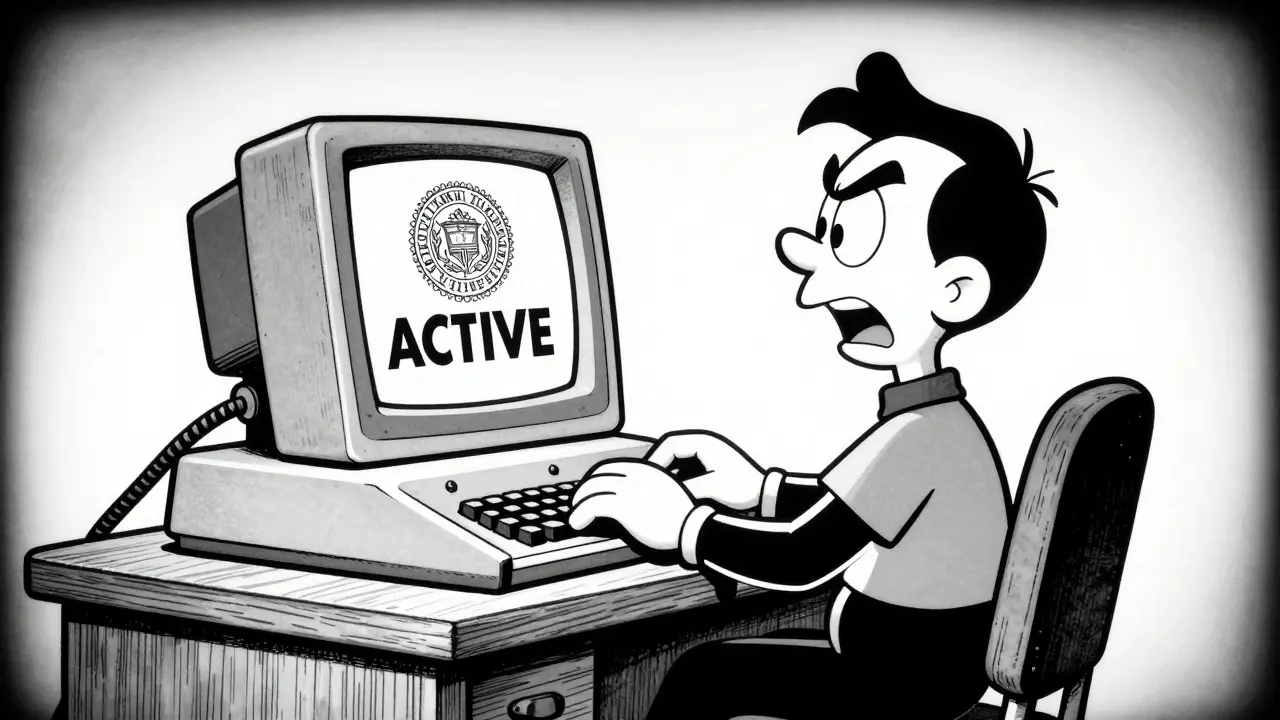
- Review the results: Look for the status. You want to see "Active." If you see "Suspended," "Revoked," or "Probation," it is a major red flag.
- Cross-reference the details: Ensure the full name and address match the pharmacy you are dealing with.
State Boards vs. NABP Verify: Which One Should You Use?
Depending on whether you are a patient or a pharmacy owner, you might encounter different tools. State boards are the legal source of truth, but the National Association of Boards of Pharmacy (or NABP) provides a more centralized approach through a service called NABP Verify. While state sites are free, NABP Verify is a paid subscription (around $59 annually) that offers digital badges for compliance and ongoing monitoring. This is a lifesaver for pharmacists who work across multiple states. Instead of checking five different state websites, they can manage everything in one place. However, for a regular consumer, the free state board lookup is more than enough to spot a fake pharmacy.| Feature | State Pharmacy Boards | NABP Verify |
|---|---|---|
| Cost | Free to the public | Annual subscription fee |
| Authority | Primary legal source | Aggregator/Monitoring service |
| Scope | Single jurisdiction | Multi-state monitoring |
| Speed | Instant lookup (usually) | Real-time digital certification |
Spotting the Red Flags: When Verification Saves Lives
Why go through the trouble? Because counterfeit drugs often come from "pharmacies" that look professional online but have no legal standing. If a pharmacy refuses to provide a license number or if that number doesn't appear in the state database, walk away. There is also the issue of "expired but active" licenses. Some states have grace periods where a license might still appear active even if the pharmacist hasn't renewed it. This is why you should check the expiration date specifically. According to a white paper by the NABP, nearly 47% of disciplinary actions involve practitioners working with invalid or expired licenses. If the date has passed and the status isn't "Active," the pharmacy is operating illegally, and the risk of receiving substandard or fake medication skyrockets.
The Challenges of Real-Time Updates
It is important to know that these systems aren't perfect. There is often a lag between a disciplinary action and the update on the website. Some experts, including law professor Dr. Susan Cornell, have pointed out that state boards can be slower to update their records than medical boards, sometimes taking up to two weeks to reflect a change. If you are an employer hiring a pharmacist, don't rely solely on a screenshot of a license. Use primary source verification-meaning you check the live site the day of hire. For patients, if a pharmacy seems "off"-perhaps they are offering prices that are too good to be true or they don't require a valid prescription-the state board lookup is your first line of defense. Even a 14-day lag in updates is better than no verification at all.The Future of Pharmacy Verification
The landscape is shifting toward more interoperability. The Interstate Pharmacy Licensure Compact (or IPLC) is a great example. It allows pharmacists to be licensed in multiple participating states more easily, reducing the paperwork nightmare. We are also seeing more rigorous requirements for license renewal. For instance, some states now mandate implicit bias training as a condition for keeping a license. As we move toward 2026, the goal is for 90% of state boards to move to real-time updates, which will virtually eliminate the dangerous gaps where a suspended pharmacist can still appear licensed online. Until then, the manual check remains the gold standard for safety.Is it free to check a pharmacy license?
Yes, almost all state pharmacy boards provide their license verification search tools free of charge to the general public via their official government websites.
What does a "Suspended" or "Revoked" status mean?
A suspended license is a temporary loss of the right to practice, while a revoked license is a permanent withdrawal. In both cases, the person or pharmacy is not legally allowed to dispense medication.
Can I trust a pharmacy if they provide a license number but it's not on the state website?
No. If a license number is not found in the official state database, it may be fake or expired. This is a major red flag for counterfeit drug operations. Contact the state board directly to double-check before purchasing.
How often should a pharmacy's license be verified?
For patients, a one-time check when choosing a new provider is usually sufficient. For employers or healthcare partners, verification should happen during the hiring process and annually thereafter.
What is the difference between a state board and the NABP?
State boards are government agencies with legal authority to grant and take away licenses. The NABP is a professional organization that supports these boards and provides tools like NABP Verify to streamline the process across different states.

Mark Zhang
This is such a helpful guide for anyone feeling overwhelmed by the healthcare system. It's really reassuring to know that these tools are free and accessible to everyone, regardless of their income level. Taking a few minutes to verify a license can truly save a life, and I appreciate the clear step-by-step instructions provided here.
Rob Newton
Government sites are usually a mess. Good luck navigating them.
Lawrence Rimmer
The whole idea of trusting a bureaucratic board is a farce. We're just shifting our faith from a pill bottle to a .gov URL, which is basically just another form of digital superstition. It's the illusion of safety in an inherently unsafe system.
simran kaur
Funny how we are told to trust the "official" board when those very boards are likely controlled by the same pharmaceutical conglomerates they claim to regulate. It is all a giant loop designed to make you feel safe while they keep the real data hidden. The gaps in real-time updates are not "accidents," they are windows for the elites to move their assets before the public notices.
Jenna Carpenter
honestly just use your gut!! if the place smells like bleach and the pharmacist looks shifty, just leave... why do people need a webiste to tell them what is obivous??
The Charlotte Moms Blog
Absolute nightmare!!! I tried doing this last month and the site crashed three times!!! Who is actually auditing these "regulatory agencies"??? The incompetence is staggering!!! My children's health is not a game for outdated software!!!
Hudson Nascimento Santos
There is an interesting tension here between the legal source of truth and the commercialization of trust via NABP. It makes one wonder if we are moving toward a future where safety is a subscription service rather than a fundamental right guaranteed by the state.
Dipankar Das
I must insist that everyone implements these checks immediately without exception. The level of negligence in some regions is absolutely appalling and completely unacceptable. We must demand absolute transparency and rigorous adherence to these protocols to ensure the safety of our citizens. Failure to verify is not just lazy; it is a dangerous gamble with human lives.
Vicki Marinker
The formatting of these state websites is usually an eyesore, and honestly, the effort required to cross-reference addresses is simply too taxing for the average person. It is quite exhausting to imagine the mental energy spent on something that should be intuitive.
sophia alex
America really is the only place that manages to make healthcare this complicated 🙄 Honestly, if you aren't using a top-tier pharmacy, you're basically playing Russian Roulette with your meds! 💊 Only the best for those of us who actually value our lives! 💅
Sakshi Mahant
It is so interesting to see how different countries handle this. In India, we have our own systems, but the core idea of verification is universal. It's wonderful to see people sharing knowledge to keep others safe across borders.
HARSH GUSANI
Why are we talking about US boards? 🇮🇳 India has the world's biggest pharmacy network and we do it better! Who cares about a .gov site in Maryland when we have the real medicine hubs here! 💊🔥💪
Brian Shiroma
Oh sure, because a two-week lag in a database update is totally fine when you're dealing with toxic fillers. Great system we have here. Truly a pinnacle of efficiency.
Hope Azzaratta-Rubyhawk
We must push for the 2026 goal of real-time updates with maximum urgency! It is absolutely imperative that we eliminate these dangerous gaps in the system immediately! No one should have to worry about a fourteen-day window of risk! This is a matter of life and death, and we must demand better from our regulatory bodies now!