

Many people start taking fiber supplements like Metamucil, Citrucel, or psyllium husk to improve digestion, lower cholesterol, or manage blood sugar. But if you’re on any kind of medication, you might be risking your treatment without even knowing it. Fiber doesn’t just help with bowel movements-it can also stop your pills from working the way they should.
Why Fiber Interferes With Medications
Fiber supplements don’t break down in your stomach or intestines. Instead, they swell up, trap water, and move through your gut like a sponge. That’s great for keeping things regular-but not so great when your pill gets caught in it. When you take a fiber supplement at the same time as a medication, the drug can stick to the fiber particles. Think of it like a magnet pulling a metal object away from its target. The medication doesn’t get absorbed into your bloodstream the way it should. Instead, it gets swept out with the rest of your waste. This isn’t just theory. Studies show that fiber can reduce how much of certain drugs your body actually uses. One study found that people taking levothyroxine (a thyroid hormone) with psyllium husk absorbed less of the drug. Their thyroid levels dropped, even though they were taking the same dose. Another study showed that fiber lowered the absorption of lithium, a mood stabilizer, and metformin, a common diabetes pill. Not all fibers affect all drugs the same way. Some, like cellulose, don’t seem to interfere much. But others-especially soluble fibers like psyllium, oat bran, and pectin-can be strong binders. And since fiber speeds up how fast food and pills move through your intestines, your body has less time to absorb the medicine.Which Medications Are Most at Risk?
Some medications are especially sensitive to fiber interference. These are often drugs with a narrow therapeutic window-meaning even a small drop in absorption can make them ineffective or cause side effects.- Levothyroxine (Synthroid, Levoxyl): This thyroid hormone is one of the most well-documented cases. Taking it with fiber can cause your TSH levels to rise, meaning your thyroid isn’t getting enough hormone. Patients have needed dose adjustments just because they started a fiber supplement.
- Metformin: Used for type 2 diabetes, metformin’s absorption can be reduced by fiber, potentially raising blood sugar levels when you least expect it.
- Lithium: For bipolar disorder, lithium needs to stay in a very tight range. Fiber can lower its levels, increasing the risk of mood swings or relapse.
- Olanzapine (Zyprexa): This antipsychotic can also be affected, leading to reduced effectiveness in managing symptoms.
- Carbamazepine: Used for seizures and nerve pain, this drug’s levels can drop when taken with fiber supplements.
- Statins like lovastatin: One study found that pectin fiber increased LDL cholesterol in people taking lovastatin-meaning the statin wasn’t working as well.
Even medications that seem safe-like blood thinners or cholesterol drugs-can be affected if taken right alongside a fiber pill. The key is not whether the drug is strong or weak, but whether your body needs a consistent, predictable amount of it to work.
How Far Apart Should You Take Them?
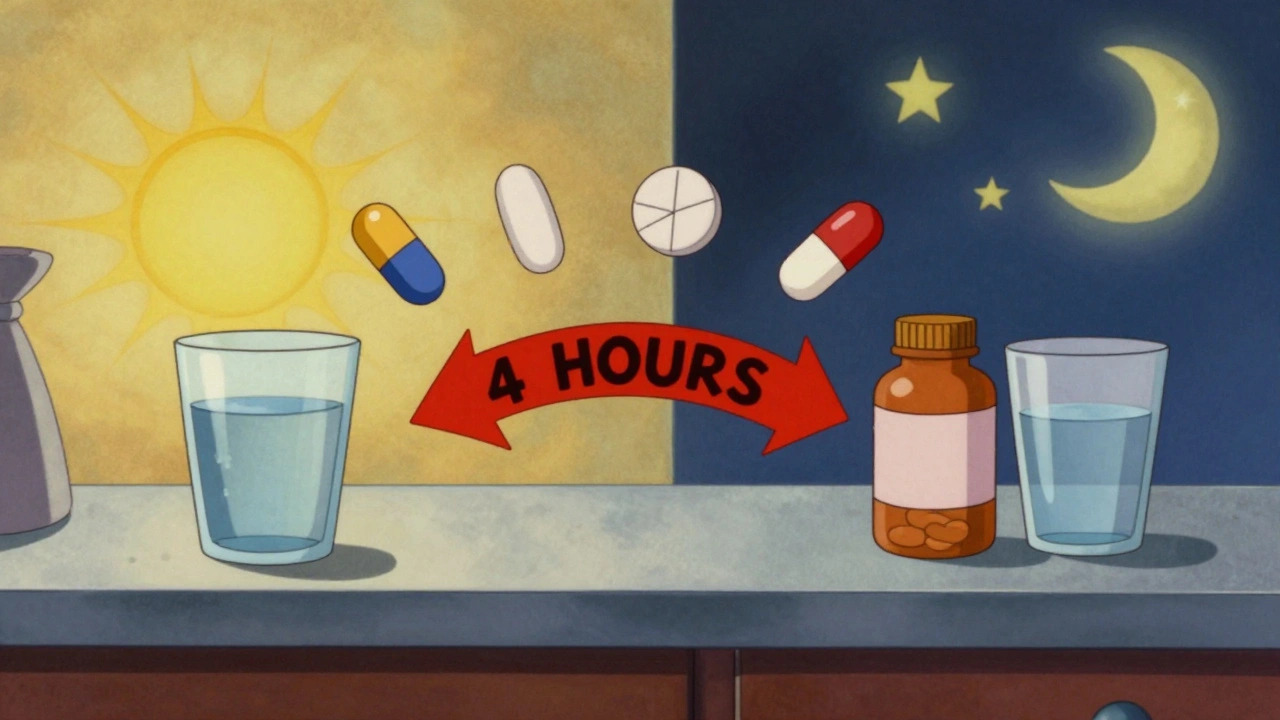
The good news? You don’t have to give up fiber. You just need to space things out. Most experts agree on the same rule: take your fiber supplement at least 2 to 4 hours before or after your medication.- For high-risk drugs like levothyroxine, lithium, or metformin, aim for 4 hours between doses.
- For most other medications, a 2-hour gap is usually enough.
Here’s a simple example:
- Take your thyroid pill first thing in the morning, on an empty stomach, with water.
- Wait until 10 a.m. to take your fiber supplement.
- Or, take your fiber at bedtime (but not right before sleep-more on that later).
- Then take your evening medications at 8 p.m., giving the fiber time to move through.
Timing matters more than you think. One study showed that even a 9% drop in levothyroxine absorption could be meaningful over time-especially if you’re already borderline on dosage. Waiting just a few hours makes all the difference.
What About Fiber From Food?
You don’t need to avoid broccoli, oats, or apples. The problem isn’t dietary fiber-it’s concentrated fiber supplements. When you eat fiber naturally, it comes with water, fat, protein, and other nutrients. That slows things down and helps your body absorb drugs more predictably. Supplements, on the other hand, are pure fiber-sometimes 5 to 10 grams in one pill. That’s like dumping a whole bowl of bran into your gut all at once. That said, if you’re eating a huge high-fiber meal right before or after your pill, it’s still smart to wait. If you’re having a bowl of oatmeal with flaxseed and berries for breakfast, and you take your thyroid pill with it, you’re still risking reduced absorption.Bottom line: Fiber from food? Usually fine. Fiber pills? Always separate.
Practical Tips for Getting It Right
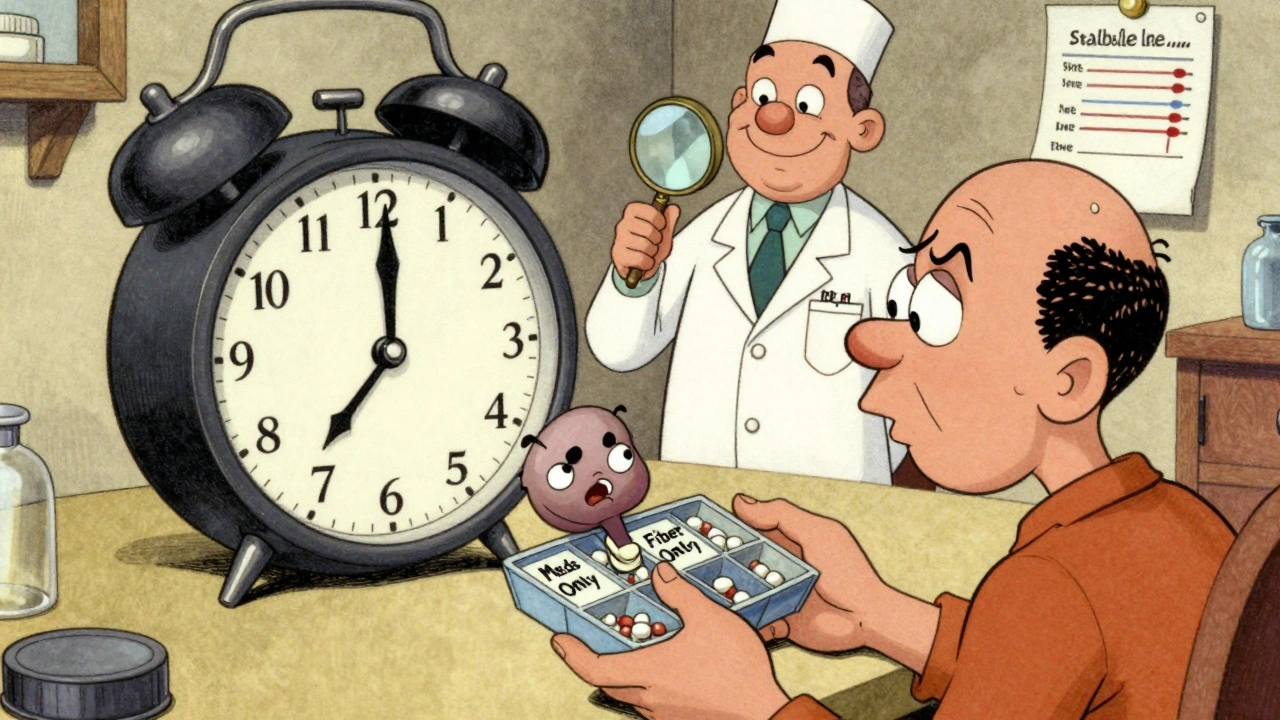
Managing this isn’t hard-but it does take planning.- Set phone alarms. If you take your medication at 7 a.m. and your fiber at 10 a.m., set two alarms: one for the pill, one for the supplement. Don’t rely on memory.
- Use a pill organizer. Label your compartments clearly: “Medication Only” and “Fiber Only.” Keep them separate.
- Don’t take fiber before bed. Many fiber supplements cause bloating, gas, and cramps. Taking them at night can disrupt your sleep-and you might forget to take your morning meds if you’re groggy.
- Drink plenty of water. Fiber needs water to work safely. Take it with at least 8 ounces (240 ml) of water to avoid choking or blockages.
- Check with your pharmacist. If you’re on more than one medication, ask them to review your list. Some pharmacies offer free med reviews.
Many people assume fiber is harmless. It’s not a drug, so they think it can’t interfere. But if your medication is meant to keep your thyroid, heart, or mood stable, even a small change in absorption can throw everything off.
What If You Already Took Them Together?
If you accidentally took your fiber and medication at the same time, don’t panic. One time won’t ruin your treatment. But if it happens often, your drug levels might be dropping without you realizing it. That’s when symptoms creep in:- For thyroid meds: fatigue, weight gain, cold intolerance, brain fog
- For metformin: higher blood sugar, increased thirst, frequent urination
- For lithium: irritability, tremors, confusion, nausea
If you notice these symptoms after starting a fiber supplement, talk to your doctor. They may need to check your blood levels and adjust your dose.
Don’t Skip Fiber-Just Separate It
Fiber is one of the most powerful tools for preventing heart disease, stroke, and type 2 diabetes. The American Heart Association recommends 25-30 grams a day. Most people get less than half that. You don’t have to choose between being healthy and taking your meds. You just need to be smart about timing. Take your fiber supplement in the afternoon or evening, away from your morning pills. Use a timer. Write it down. Ask your pharmacist. A little planning now saves you from a lot of trouble later.It’s not about avoiding fiber. It’s about respecting how your body works-and making sure your medication can do its job.
Can I take fiber supplements with my morning coffee?
Yes, as long as you don’t take your medication with it. Coffee doesn’t interfere with fiber, but if you take your thyroid pill or other meds with coffee, wait at least 30 minutes after the coffee before taking fiber. The issue isn’t the coffee-it’s the timing with your meds.
Does it matter what kind of fiber supplement I take?
Yes. Soluble fibers like psyllium (Metamucil), oat bran, and pectin are more likely to bind to medications than insoluble fibers like cellulose. But since most supplements are soluble, it’s safest to assume all fiber pills need separation. Stick to the 2-4 hour rule regardless of brand.
Can I take fiber with vitamins or supplements?
Yes, but be cautious. Many vitamins and minerals-like calcium, iron, and zinc-can also be affected by fiber. If you take a multivitamin, take it at least 2 hours before or after your fiber supplement. Don’t assume natural means safe.
What if I forget and take them together?
One mistake won’t hurt. But if it happens regularly, your drug levels may be too low. Monitor for symptoms like worsening fatigue, mood changes, or uncontrolled blood sugar. Talk to your doctor about checking blood levels if this happens often.
Is it safe to take fiber at bedtime?
It’s okay if you space it properly from your nighttime meds. But many people experience bloating or cramps after taking fiber at night, which can disrupt sleep. If you’re sensitive, take it earlier in the day. Always drink plenty of water.





Emma Sbarge
Fiber supplements are a scam pushed by big health companies to sell you more junk. I’ve been taking psyllium for years and my thyroid levels are perfect. If your meds aren’t working, maybe you’re just not taking them right-not because of fiber.
Stop overcomplicating everything. People used to live on whole foods and survive just fine.
Michael Gardner
So let me get this straight-you’re telling me I can’t take my Metamucil with my coffee because it might mess with my lithium? I’ve been doing this for five years and I’m still functional. This sounds like medical fearmongering dressed up as advice.
Next they’ll say sunlight interferes with antidepressants.
Hamza Laassili
OMG I JUST REALIZED I’VE BEEN TAKING MY METFORMIN WITH MY FIBER AT THE SAME TIME FOR 3 YEARS!!
MY BLOOD SUGAR HAS BEEN ALL OVER THE PLACE!! I’M SO STUPID!!
WHY DIDN’T ANYONE TELL ME THIS?!?!
MY PHARMACIST JUST LOOKED AT ME LIKE I WAS FROM ANOTHER PLANET WHEN I ASKED…
SO NOW I’M DOING 4 HOURS BETWEEN…
AND I JUST SET 3 ALARMS…
ONE FOR MEDS, ONE FOR FIBER, ONE FOR WATER…
WHY IS THIS SO HARD?!
WHY DOESN’T THE BOX SAY THIS?!
THEY SHOULD BE FORCED TO PRINT THIS ON THE LABEL!!
THIS IS A PUBLIC HEALTH CRISIS!!
Constantine Vigderman
YESSSS!! This is the kind of info that saves lives!!
Thank you for writing this!! 🙌
I was about to give up on fiber because I thought it was making me bloated and tired… turns out it was my thyroid med not working!
Now I take my levothyroxine at 6am, coffee at 6:30, fiber at 10am, and my other meds at 8pm.
My energy is back, my brain fog lifted, and I actually feel like myself again!!
Don’t let anyone tell you fiber is harmless-it’s powerful stuff!!
PS: Drink water, people!! I used to take mine dry and nearly choked. Not cool. Not cool at all. 💧❤️
Cole Newman
Why are you all so obsessed with timing? You know what I do? I take everything together and just up my dose a little. Works fine. My doctor doesn’t care. You’re overthinking this.
Also, if your meds are that fragile, maybe you shouldn’t be on them. Life’s messy. Adapt.
Casey Mellish
As an Australian who’s been managing bipolar disorder with lithium for over a decade, I can confirm this is 100% accurate.
My endocrinologist in Sydney drilled this into me: 4 hours between fiber and meds. No exceptions.
I used to think it was overkill-until I had a manic episode after switching to a new psyllium brand. Turned out the fiber was more concentrated.
Now I keep a little logbook. It’s not hard. Just write it down. And yes, water matters-especially in this dry climate.
Don’t risk your stability for convenience. You’re worth the extra effort.
kevin moranga
Hey, I just want to say-this is such an important post and I’m so glad you shared it.
I used to be one of those people who thought fiber was just for constipation, you know? Like, it’s not a drug, so it can’t hurt.
But when my mom started taking Metamucil and her blood pressure meds stopped working, we realized it was the fiber.
Now we’ve got a whole system: meds at 7am, fiber at 11am, vitamins at 4pm, and fiber again at 8pm (with water, always).
It’s not perfect, but it’s working.
And honestly? It’s made me feel more in control of my health than ever before.
You’re not just helping yourself-you’re helping people like my mom, who don’t even know to ask these questions.
Keep spreading the word. You’re doing great work.
Bruno Janssen
I’ve been taking fiber with my meds for years. I don’t care what the studies say.
I’m tired. I’m sad. I don’t feel like doing anything.
It’s easier to just take it all at once.
Maybe I’m just broken.
Maybe I don’t deserve to feel better.
Donna Hammond
Thank you for this. As a nurse who works in endocrinology, I see this every single day.
Patients come in with wildly elevated TSH levels, confused why their Synthroid dose hasn’t changed.
They swear they’re taking it right-until I ask about their morning routine.
‘Oh, I take my fiber with my coffee.’
Boom. That’s your problem.
And yes, it’s not just thyroid meds. I’ve seen metformin fail, lithium levels crash, even statins lose effectiveness-all because someone thought ‘fiber is natural, so it’s safe.’
It’s not. It’s a pharmacokinetic disruptor.
But here’s the good news: once you separate them, things normalize. No dose changes needed. Just timing.
Don’t be afraid to ask your pharmacist. They’re your secret weapon.
You’re not being paranoid. You’re being smart.
Richard Ayres
This is an exceptionally well-researched and clearly presented guide. I appreciate the emphasis on separating fiber from medications-not as a rigid rule, but as a practical safeguard based on pharmacological evidence.
It’s also thoughtful to distinguish between dietary fiber and supplements, as many confuse the two.
The inclusion of specific drug examples and timing recommendations adds immense clinical value.
One minor suggestion: while the 2–4 hour window is sound, it may be helpful to note that some extended-release formulations may require longer separation, depending on the drug’s release profile.
Thank you for taking the time to compile this. It’s the kind of information that should be widely disseminated-not just on Reddit, but in doctor’s offices and pharmacy handouts.