

Imagine waking up one morning and noticing your vision feels blocked-not by fatigue, but by your own eyelid. Or maybe your eye feels like it’s constantly scratched, even though you haven’t rubbed it. These aren’t just minor annoyances. They could be signs of ptosis or entropion, two common but serious eyelid disorders that can affect your sight and comfort if left untreated.
What Is Ptosis?
Ptosis is when the upper eyelid droops low enough to cover part of the pupil. It can happen in one or both eyes and ranges from barely noticeable to severe enough to block vision completely. People often describe it as having to lift their eyebrows just to see clearly, or feeling like their eyes are always tired-even after a full night’s sleep. The most common cause is aging. Over time, the levator muscle, which lifts the eyelid, stretches and weakens. This is called involutional ptosis, and it accounts for the majority of cases in adults over 60. But ptosis isn’t always about age. Some people are born with it (congenital ptosis), often due to underdeveloped eyelid muscles. Others develop it after eye surgery, trauma, or nerve damage from conditions like diabetes or myasthenia gravis. Doctors measure ptosis using something called the margin reflex distance (MRD). A normal MRD is 4-5 mm. Mild ptosis is a droop of 1-2 mm, moderate is 2-3 mm, and severe is more than 3 mm. If your eyelid covers more than a third of your pupil, it’s likely affecting your vision and should be evaluated.What Is Entropion?
Entropion is the opposite problem: the eyelid turns inward. Most often, it’s the lower eyelid that rolls inward, causing eyelashes to rub against the cornea-the clear front surface of your eye. This constant friction feels like sand in your eye. It leads to redness, tearing, mucus buildup, and, if untreated, corneal scratches or ulcers that can permanently damage your vision. About 80% of entropion cases in Western countries are involutional-caused by age-related loosening of eyelid tissues and weakening of the muscles that hold the lid in place. The rest are usually due to scarring (cicatricial entropion) from past infections, burns, or surgeries. In places with poor sanitation, trachoma, a bacterial infection caused by Chlamydia trachomatis, is still a leading cause of entropion. The most telling symptom? A persistent feeling that something’s in your eye. People often blink more, rub their eyes (which makes it worse), or avoid bright light. If you’re over 70 and have this symptom, it’s not just dry eyes-it could be entropion.Related Conditions: Blepharitis and Trichiasis
You won’t usually see ptosis or entropion alone. They often come with blepharitis, a chronic inflammation of the eyelid margins. Blepharitis causes crusting, redness, and oily debris along the lash line. It’s not contagious, but it’s persistent. Left unchecked, it can lead to trichiasis-where eyelashes grow inward instead of outward. These misdirected lashes act like tiny brushes scraping your cornea every time you blink. Ocular rosacea is another hidden player. It’s an inflammatory condition that affects the oil glands in the eyelids, causing burning, blurred vision, and swelling. It’s often mistaken for allergies or dry eye, but it worsens both ptosis and entropion by weakening the eyelid structure over time.Surgical Repair for Ptosis
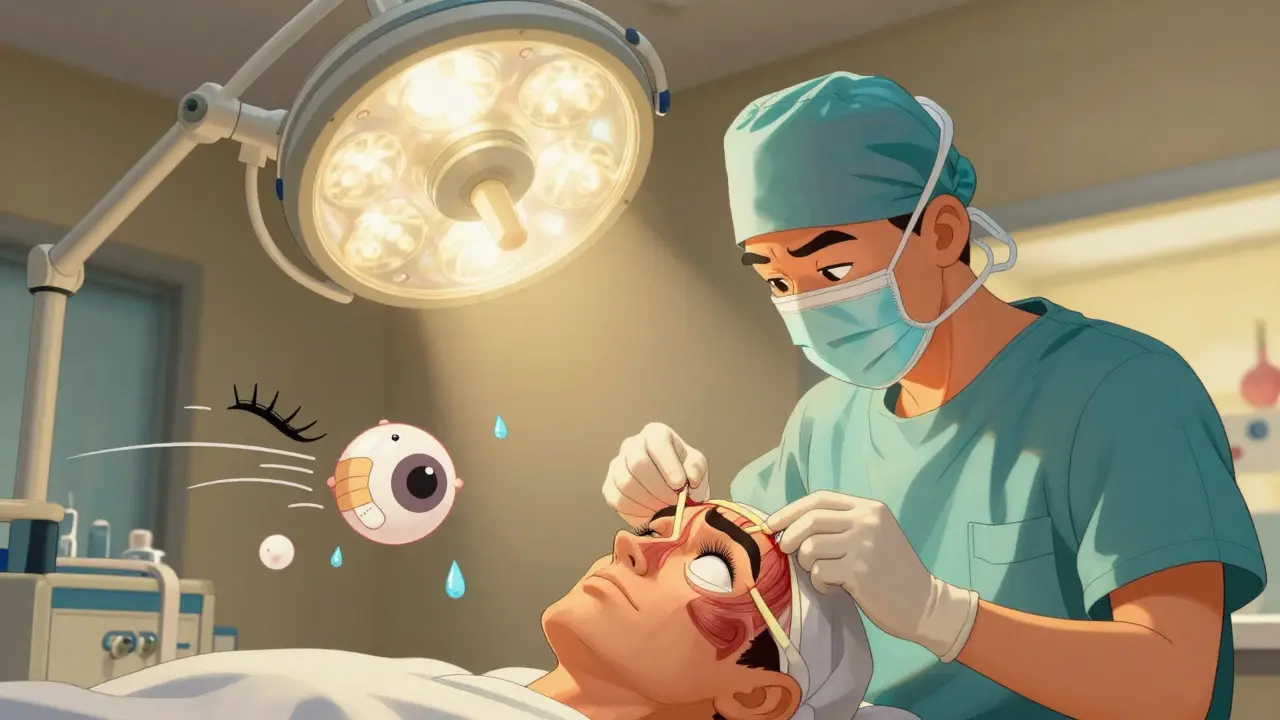
When ptosis interferes with daily life, surgery is the only permanent fix. The type of surgery depends on how strong your levator muscle still is. If your levator function is good (more than 4 mm of movement), a levator resection is usually done. The surgeon tightens the muscle to lift the eyelid. Success rates are 85-95% for first-time surgeries. If the muscle is very weak-common in congenital cases or after nerve damage-a frontalis sling is used. This connects the eyelid to the forehead muscle (frontalis), so you lift your eyelid by raising your eyebrows. It’s effective but can look less natural. For mild cases, especially in older adults with good skin elasticity, a Müller’s muscle-conjunctival resection might be enough. It’s a shorter procedure with faster recovery. Newer techniques, like adjustable sutures introduced in 2018, let surgeons fine-tune the eyelid height the same day after surgery. This reduces the chance of needing a second operation by about 25%.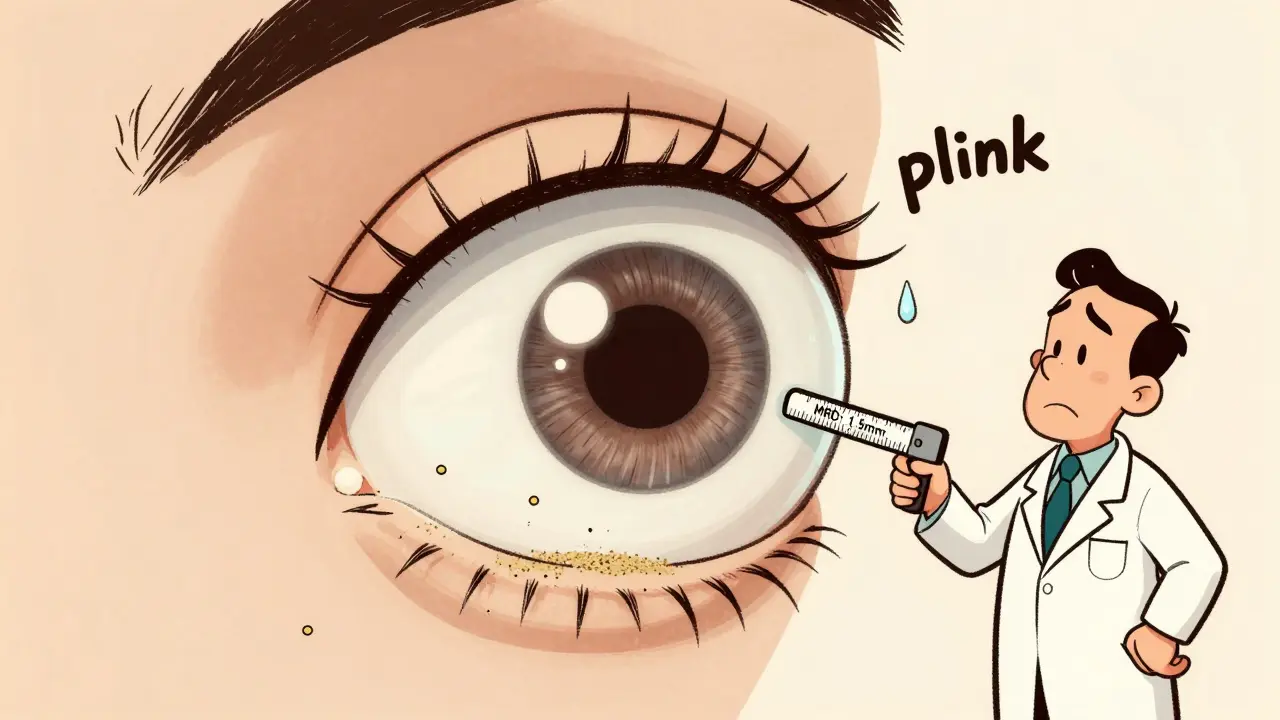
Surgical Repair for Entropion
Entropion surgery aims to reposition the eyelid so lashes point away from the eye. The method depends on the cause. For involutional entropion (the most common type), the tarsal fracture procedure is the gold standard. It involves tightening the eyelid’s supporting structures and has a 90-95% success rate. If scarring is the issue-say, from a past injury or infection-a tarsal wedge resection removes a small piece of the eyelid to pull it back into place. This is more complex and usually done by specialists. For temporary relief, the Quickert suture technique can be used. It’s a simple stitch that flips the lid outward. But it only lasts a few months and has a 60-70% success rate. It’s not a cure-it’s a bridge to surgery. New minimally invasive methods using absorbable sutures have cut recovery time from 4-6 weeks down to 1-2 weeks. Patients report less swelling and quicker return to normal activities.When Surgery Isn’t the First Step
Not everyone needs surgery right away. For mild cases, doctors often recommend conservative care first:- Lubricating eye drops or ointments to protect the cornea
- Taping the eyelid upward at night to reduce exposure
- Warm compresses and eyelid scrubs for blepharitis
- Epilation (plucking) of misdirected lashes for trichiasis
- Electrolysis or laser treatment to destroy faulty hair follicles
Risk Factors and Warning Signs
You’re more likely to develop ptosis or entropion if you:- Are over 60 years old
- Have a history of eye surgery or trauma
- Wear contact lenses regularly (raises ptosis risk by ~30%)
- Have chronic eye inflammation or rosacea
- Have a family history of eyelid disorders
- Rapid drooping of the eyelid (could signal nerve damage)
- Blurred vision or light sensitivity
- Redness, pain, or discharge from the eye
- A feeling that something is scratching your cornea
What Happens After Surgery?
Recovery is usually quick. Swelling and bruising peak in the first 48 hours and fade over 1-2 weeks. Most people return to normal activities within 7-10 days. You’ll need to avoid heavy lifting, swimming, and rubbing your eyes for at least two weeks. Complications are rare but possible. For ptosis surgery, about 5-10% of patients end up with an eyelid that’s too high (overcorrection), and 3-8% have it still too low (undercorrection). Lid asymmetry happens in up to 15% of cases, especially if one eye was worse than the other. For entropion, recurrence occurs in 5-15% of cases, depending on the technique used. Scarring and infection are uncommon (under 5%) but require prompt treatment.Why This Matters Now
The global market for eyelid surgery is growing fast-projected to hit $2.7 billion by 2028. Why? Because people are living longer. About 5% of adults over 70 have some form of eyelid malposition. In Australia, where life expectancy is among the highest in the world, these conditions are becoming more common in clinics and optometry practices. It’s not just cosmetic. When your eyelid blocks your vision or damages your cornea, it affects driving, reading, walking safely, and even your independence. Early diagnosis and timely surgery can restore not just your sight-but your quality of life.What Comes Next?
If you suspect you have ptosis or entropion, start with your optometrist or general practitioner. They can check your eyelid position, measure your MRD, and rule out other causes like dry eye or neurological issues. If needed, they’ll refer you to an oculoplastic surgeon-a specialist trained in eyelid structure and function. Don’t wait for symptoms to get worse. A drooping lid or an inward-turning lash might seem small, but the damage they cause is real-and preventable.Can ptosis or entropion fix itself without surgery?
No, neither ptosis nor entropion resolves on its own. While temporary relief can come from eye drops, taping, or eyelid scrubs, these only manage symptoms. The structural changes causing the eyelid to droop or turn inward are permanent without surgical correction. Delaying treatment risks permanent corneal damage, especially in entropion.
Is eyelid surgery covered by insurance?
Yes, if the condition affects your vision. Insurance providers typically cover ptosis or entropion surgery when it’s deemed medically necessary-like when the eyelid blocks your pupil or causes corneal injury. Cosmetic eyelid lifts (blepharoplasty) are not covered, but functional repairs are. Your surgeon will usually provide documentation to support your claim.
How do I know if I have ptosis or just tired eyes?
Tired eyes improve with rest. Ptosis doesn’t. If you’re constantly lifting your eyebrows to see, need to tilt your head back, or your eyelid feels heavy even after sleeping, it’s likely ptosis. A simple test: cover one eye and see if the other eye’s vision improves. If it does, your eyelid may be blocking your view. An optometrist can measure your margin reflex distance to confirm.
Can I use makeup or contact lenses after surgery?
Wait at least two weeks before using eye makeup or wearing contact lenses. Makeup can introduce bacteria, and contacts can rub against healing tissue. Your surgeon will give you specific instructions based on your procedure. Always use clean tools and fresh products after surgery to avoid infection.
Are there non-surgical alternatives to treat entropion?
Temporary options include taping the eyelid outward, using special contact lenses to protect the cornea, or injecting botulinum toxin to relax overactive muscles. These help in the short term but aren’t long-term solutions. For involutional or cicatricial entropion, surgery is the only way to permanently correct the eyelid position and prevent vision loss.

Brian Anaz
This is why America needs to stop letting old people drive. If your eyelid is drooping, you shouldn't be on the road. Simple as that.
Venkataramanan Viswanathan
In India, we have seen many cases where entropion was misdiagnosed as conjunctivitis. The lack of access to oculoplastic surgeons in rural areas leads to irreversible corneal damage. Early referral is critical.
Vinayak Naik
Yo, I had this weird thing where my eyelid kept flipping inside like a taco shell. Felt like my lashes were sandpapering my eyeball. Went to the doc, they were like 'dude, that's entropion'-I thought it was just dry eyes from scrolling too much. Got the Quickert suture thing, felt like a superhero for a week. Then it came back. Surgery’s the real MVP.
Harshit Kansal
I swear my grandma has been taping her eyelids up since 2012. She calls it 'eyelid yoga'. I think she’s just trying to avoid the surgeon’s bill. But honestly? It works better than half the stuff they sell on TV.
Ryan Barr
Inefficient. Overpriced. Underregulated.
Indra Triawan
Sometimes I wonder if our bodies are just giving up on us… like the eyelid is the first to surrender when the soul gets tired. Maybe it’s not a medical condition-it’s a metaphor.
Mukesh Pareek
The involutional pathophysiology of lid malposition is fundamentally tied to elastin degradation and collagen remodeling in the tarsal plate, compounded by neuromuscular denervation. Conservative management is palliative at best. Surgical intervention must be anatomically precise-levator resection with MRD quantification is the only evidence-based approach.
Matt Beck
I had ptosis… and it changed my life 😔. Not because I couldn't see… but because I realized how much I took my vision for granted. Now I cry every time I see the sunrise. 🌅👁️
Molly McLane
If you're over 60 and your eyelid feels like it's trying to nap on your pupil-don't ignore it. Talk to your optometrist. They’re not just there for glasses. Seriously, your eyes are doing you a solid by not going blind yet. Be kind to them.
Katie Schoen
So let me get this straight… we’re paying thousands to surgically fix something that’s just… aging? Like, can’t we just invent eyelid botox that lasts 10 years? I mean, we have self-driving cars now. Why are people still getting stitches in their eyelids?
Beth Templeton
Surgery. Not a suggestion.
Cam Jane
Hey, if you’re reading this and you think your droopy lid is just 'tired eyes'-please, please, please don’t wait. I waited 3 years. I thought it was stress. Turns out I was barely seeing half my screen. Got the levator resection last month. I can now read my phone without tilting my head like a confused owl. And no, I didn’t need to raise my eyebrows anymore. It’s like getting a new pair of eyes. You’re not being dramatic-you’re being smart. Go see someone. Your future self will high-five you.
Pavan Vora
I had entropion, and I tried everything-eye drops, warm compresses, even taping it with medical tape… but it kept coming back… and I was so scared… I didn’t know what to do… then I found a doctor in Delhi who did the tarsal fracture… and now… I can blink without crying… thank you… thank you…