

INR Target Range Calculator
When you're on a blood thinner like warfarin, your life changes in ways you might not expect. It’s not just about taking a pill every day. It’s about knowing your INR - a number that tells you whether your blood is clotting at the right speed. Get it wrong, and you risk a stroke or a dangerous bleed. Get it right, and you live with far less fear. This isn’t theory. It’s daily reality for millions.
What Exactly Is INR?
INR stands for International Normalized Ratio. It’s a number doctors use to measure how long it takes your blood to clot. The test starts with a simple blood draw or finger prick. A lab or home device adds a chemical that triggers clotting, then times how long it takes. That raw time is called prothrombin time (PT). But here’s the catch: different labs use different reagents. One lab’s 15 seconds might be another’s 17. That’s where INR comes in.
INR standardizes that number. It adjusts the PT result based on how sensitive the test reagent is. The formula? INR = (Patient PT ÷ Mean Normal PT)^ISI. The ISI - International Sensitivity Index - is unique to each test kit. This system was created by the World Health Organization in 1983 because doctors needed a universal language. Before INR, a patient’s warfarin dose could be adjusted wildly just because they switched clinics. Now, an INR of 2.5 means the same thing whether you’re in Melbourne, Chicago, or Sydney.
For someone not on blood thinners, INR is always 1.0. That’s normal clotting speed. But if you’re on warfarin, your target is higher - usually between 2.0 and 3.0. That doesn’t mean your blood is thin. It means it takes 2 to 3 times longer to clot than normal. Enough to stop dangerous clots, but not so much that you bleed out from a cut.
Why Your Target Changes Based on Your Condition
Your INR target isn’t one-size-fits-all. It depends on why you’re on warfarin in the first place.
- If you have atrial fibrillation (AFib), your target is usually 2.0-3.0. This range cuts stroke risk by 42%, according to the American Heart Association.
- If you’ve had a deep vein thrombosis (DVT) or pulmonary embolism (PE), the same range applies - 2.0-3.0.
- If you have a mechanical heart valve, especially in the mitral position, your target jumps to 2.5-3.5. These valves are more likely to cause clots, so you need stronger anticoagulation.
- For mechanical aortic valves, the target stays at 2.0-3.0, unless you have other risk factors like prior clots or AFib.
Going above or below these ranges has real consequences. Studies show that each 0.5-point increase above 3.0 raises your risk of major bleeding by 27%. And if your INR drops below 1.5? You’re at serious risk of a clot forming. That’s why your doctor doesn’t just check your INR - they track it over time.
Time in Therapeutic Range (TTR): The Real Measure of Success
It’s not enough to hit your target once. What matters is how often you stay in range. That’s called Time in Therapeutic Range, or TTR. A single INR of 2.8 doesn’t mean much if your next reading is 4.5, then 1.8. The goal is consistency.
Hospitals that keep their patients’ TTR above 65% see 42% fewer strokes and clots. Patients who maintain TTR above 70% cut their major bleeding risk by 15% for every 10% increase in TTR. That’s not a small win - it’s life-saving. Yet, many patients drift in and out of range. Why? Because warfarin is finicky. It reacts to food, other drugs, even changes in your sleep or stress levels.
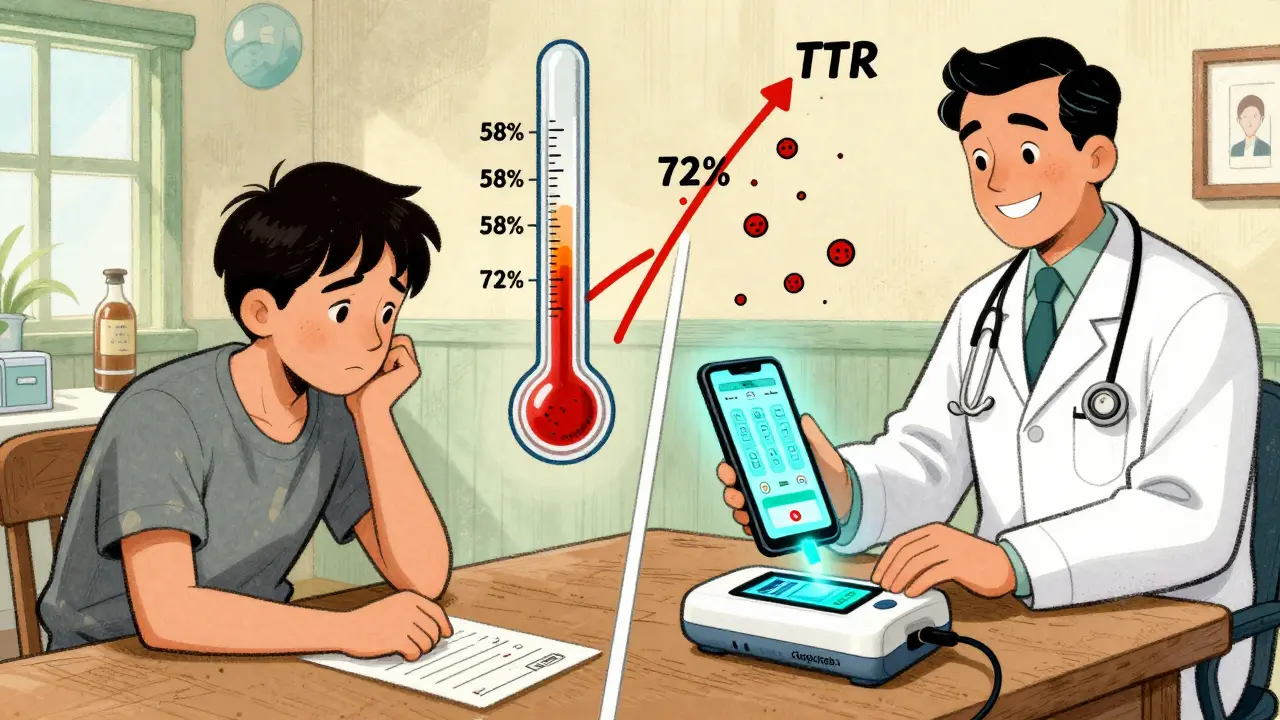
That’s why home testing is changing the game. With devices like the Abbott Acelis or Roche CoaguChek, you can test yourself in minutes. You prick your finger, apply a drop of blood, and get a result in under a minute. No waiting. No clinic appointments. And it works. Studies show home users achieve TTR of 72% - compared to 58% for clinic-only users. That means 34% fewer clots and 21% fewer bleeds.
Home Testing: Convenience vs. Challenges
Home INR monitors are FDA-approved and widely used. They require just 10-15 microliters of blood - about one drop. The devices cost around $299 upfront, with test strips at $5.99 each. In Australia, private insurance often covers part of the cost. Medicare in the U.S. covers 100% for eligible patients. But it’s not for everyone.
People with arthritis, poor eyesight, or tremors struggle with the finger prick. One Reddit user, u/ClotSurvivor, said: “After 3 years, I still miss the capillary tube 1 in 5 tests. I waste $6 every time.” That’s not just money - it’s frustration. Training takes 2-4 sessions. You need to learn how to apply the blood correctly, read the device, and report results accurately.
Still, the benefits are clear. A 2022 survey by the National Blood Clot Alliance found that 57% of mechanical valve patients preferred home testing - even if they paid more out of pocket. Why? They saved an average of $187 per clinic visit and avoided the anxiety of missing appointments. For working adults or those in rural areas, this isn’t a luxury - it’s essential.
But here’s the catch: 25-30% of patients aren’t good candidates. The FDA warns that elderly patients over 65 report only 3.1/5 satisfaction with home testing, compared to 4.3/5 for younger users. If you can’t see the screen, hold the device steady, or remember to test, it’s not the right path.
Warfarin vs. DOACs: The New Alternatives
You might be wondering: why not just switch to a newer drug like apixaban or rivaroxaban? These are called direct oral anticoagulants (DOACs). They don’t need INR monitoring. You take them once or twice a day. No blood tests. No diet changes.
But here’s the reality: DOACs aren’t for everyone. They’re expensive - $550 to $650 a month. Warfarin? Around $4. That’s why, despite DOACs making up 70% of new prescriptions, warfarin is still used by 3.2 million Americans. Why? Because DOACs can’t be used if you have a mechanical heart valve. They’re also risky if you have severe kidney disease. And if you’re on dialysis? Warfarin is your only option.
Plus, DOACs don’t have a reliable reversal agent for every type. Warfarin’s reversal is well understood: vitamin K and fresh frozen plasma. If you bleed badly, doctors know exactly how to fix it. With DOACs, it’s more complicated.
So while DOACs are easier, warfarin is still essential. And if you’re on warfarin, INR monitoring isn’t optional - it’s your safety net.

How to Stay in Range: Practical Tips
Here’s what actually works:
- Test at the same time each day. Ideally between 8 a.m. and noon. Your body’s clotting factors fluctuate naturally. Consistency matters.
- Fasting helps. Avoid eating for 4-6 hours before your test. Heavy meals, especially those high in vitamin K (like kale, spinach, broccoli), can lower your INR.
- Keep a log. Write down your INR, dose, diet, medications, and how you felt. Patterns emerge. Maybe your INR drops every time you take ibuprofen. Or rises when you start a new antibiotic.
- Don’t skip tests. Even if you feel fine. INR can swing fast. One missed test can mean a dangerous spike.
- Know your danger zones. INR below 1.5? Call your doctor. INR above 5.0? Hold your next warfarin dose and contact your provider within 24 hours. Don’t wait.
And if you’re using a home device? Make sure it’s calibrated. The FDA found that 12% of home monitors showed more than 10% error at INR levels above 4.0. That’s not rare - it’s critical. Always double-check if your result seems off.
The Future: AI, Connectivity, and Access
The next wave of INR monitoring is smarter. In January 2023, the FDA approved the first smartphone-connected INR device - the Bayer CoaguChek ProConnect. It automatically sends results to your doctor. In trials, it was 98.7% accurate. No manual entry. No missed reports.
AI tools like the INR Advisor platform are now predicting your next warfarin dose with 83% accuracy. They analyze your history, diet, medications, and even weather patterns (yes, temperature affects clotting). This isn’t sci-fi - it’s happening now.
But access is uneven. Rural areas have only 35% of the anticoagulation services urban clinics offer. That’s a gap. And as DOACs grow - projected to make up 85% of new starts by 2028 - warfarin users risk being left behind. The National Blood Clot Alliance warns: without better access to home testing, rural, elderly, and low-income patients will see worse outcomes.
For now, if you’re on warfarin, your INR is your lifeline. Not a number on a chart. A daily check-in with your body. A quiet way to stay alive.
What is a normal INR level if you’re not on blood thinners?
For someone not taking anticoagulants, the normal INR is always 1.0. This means your blood clots at the standard rate. Any reading significantly above or below 1.0 usually indicates a medical issue, such as liver disease, vitamin K deficiency, or the use of blood-thinning medication.
Can I check my INR at home?
Yes, with FDA-approved devices like the Abbott Acelis or Roche CoaguChek. These require a small drop of blood from a finger prick and give results in under a minute. Home testing is recommended for patients who are stable on warfarin, can perform the test correctly, and have support from their healthcare provider. Medicare and many private insurers cover the cost for eligible users.
How often should I test my INR?
When you first start warfarin, you may need testing every few days until your dose stabilizes. Once stable, most patients test once a month. If your INR fluctuates or you change medications, diet, or health status, your doctor may ask for testing twice a week. Home users often test weekly or biweekly, depending on their stability and provider guidelines.
What happens if my INR is too high or too low?
If your INR is too low (below 1.5), your blood clots too easily - increasing your risk of stroke or clotting in your legs or lungs. If it’s too high (above 5.0), you’re at high risk of serious bleeding - even from minor injuries. Your doctor will adjust your warfarin dose accordingly. An INR over 4.9 requires urgent medical attention. Never change your dose without consulting your provider.
Why do I need to watch my diet if I’m on warfarin?
Vitamin K helps your blood clot, and warfarin works by blocking vitamin K. If you suddenly eat a lot of leafy greens like spinach or kale, your INR can drop. If you stop eating them, your INR can rise. The key isn’t to avoid these foods - it’s to eat them consistently. Keep your vitamin K intake steady so your INR stays predictable.
Final Thought: Your INR Is Your Control
Warfarin isn’t a cure. It’s a tool. And INR monitoring is how you use it wisely. It’s not about perfection. It’s about awareness. About showing up for your tests. About knowing your numbers. About talking to your doctor when something feels off. The goal isn’t to live in fear - it’s to live with confidence. Because with every test, you’re not just checking a number. You’re protecting your life.




Allison Priole
I've been on warfarin for 6 years now and honestly? Home testing changed my life. I used to dread those clinic visits - the waiting room, the nurse asking if I ate spinach last week, the awkward silence while they wait for results. Now I do it in my pajamas while drinking coffee. My TTR went from 52% to 78%. I don't even think about it anymore. It's just part of my routine, like brushing my teeth. And yeah, sometimes I mess up the finger prick and waste a strip, but $6 is cheaper than a hospital trip.
Also, vitamin K is not the enemy. I eat kale every day. Consistency is key. Don't go from zero greens to a salad bar overnight. That's how you end up with an INR of 1.2 and a panic attack.
Casey Tenney
DOACs are the future. Warfarin is a 1950s relic. Why are we still making people poke their fingers and track diet like it's a cult?
Sandy Wells
The article is well written but it ignores the fact that most people can't afford home monitors even with insurance. And let's be real - the FDA approval doesn't mean it's safe for grandma with shaky hands and no reading glasses. This feels like tech bros solving a problem that doesn't exist for 60% of patients
Bryan Woody
Let me break this down for you people who think DOACs are magic. They're expensive. They can't be reversed easily. And if you have a mechanical valve? You're stuck with warfarin. No ifs, ands, or buts.
Home testing isn't about convenience - it's about survival. I had a friend who missed three tests because her bus route got canceled. Three weeks later she had a pulmonary embolism. She's fine now but she's on oxygen.
INR isn't a number. It's your heartbeat in decimal form. If you're not testing, you're gambling. And no, your 'feeling fine' doesn't count. Blood doesn't care how you feel.
Chris Dwyer
You got this. Seriously. I know it feels overwhelming at first. The finger pricks, the strips, the logbook, the doctor calls. But once it becomes routine? It's empowering. You're not just taking a pill anymore. You're in control. I started home testing 18 months ago. My INR used to swing like a pendulum. Now? I'm steady as a rock.
And yeah, vitamin K is weird. But you don't have to stop eating greens. Just keep it the same. Same amount. Same day. Same meal. Your body likes predictability. So do your clotting factors.
Timothy Olcott
DOACs are a Big Pharma scam 🤡💸 They don't want you to know that warfarin works better for mechanical valves. And don't get me started on how the FDA is in bed with the device companies. I saw a video on TikTok where some guy's home monitor gave him an INR of 8.2 but his clinic said 2.9. That's not a glitch. That's a conspiracy. 🧠🩸
Desiree LaPointe
How quaint. You're all treating this like a lifestyle hack. 'Oh I eat kale every Tuesday' as if this were a yoga retreat. This isn't about mindfulness. This is about molecular biology. The INR isn't a spiritual metric. It's a pharmacokinetic variable. And if you think consistency is about 'routine' rather than mathematical precision, you're missing the entire point.
Also, the CoaguChek? Overpriced. The Abbott device has a 12% error rate above INR 4.0. You're not monitoring. You're approximating. With your life.
Jackie Tucker
I used to think INR was just a number. Then I read a paper on fibrinogen kinetics during circadian rhythm fluctuations and realized how naive I was.
It's not about 'testing at 8am'. It's about understanding how cortisol peaks at 6-8am alter hepatic CYP450 enzyme activity, which modulates warfarin metabolism. The 'same time each day' advice? It's not a suggestion. It's a biological imperative.
And vitamin K? Please. It's not about 'eating greens consistently'. It's about the K1 to K2 ratio in your gut microbiome, which varies by antibiotic exposure, probiotic use, and even sleep hygiene.
Most people treat this like a diet plan. It's not. It's a dynamic system. You're not managing a number. You're managing a biochemical cascade.
Thomas Jensen
I don't trust these home devices. I swear my neighbor is hacking my monitor. Last week my INR jumped to 5.8 and I didn't change anything. I think the government is using it to track anticoagulant users. Maybe they want to control who lives and who dies. I saw a documentary once about microchips in test strips. I'm not paranoid. I'm prepared.
matthew runcie
I've been on warfarin for 11 years. Home testing saved me. The key isn't perfection. It's showing up. Even if you mess up a test, do another. Even if you skip a day, do it tomorrow. Don't let guilt stop you. Your body isn't keeping score. You are.
shannon kozee
If you're on warfarin and your INR is unstable, ask your doctor about a coagulation clinic. Some hospitals have specialized teams. They're not just for emergencies. They're for people like us. I didn't know they existed until I was in the ER with an INR of 6.2. Now I go monthly. My TTR is 81%. It's not magic. It's structure.
trudale hampton
I used to hate testing. Now I kind of like it. It's my quiet moment. I sit by the window, prick my finger, watch the blood get sucked into the strip. It's weirdly calming. Like a ritual. I don't know why. But I do it. And it works.
Shaun Wakashige
I tried home testing. Didn't work. Too hard. My hands shake. I keep missing the strip. I'm just gonna stick with the clinic. It's easier. 🤷♂️
Paul Cuccurullo
The most important thing to remember is that INR is not a reflection of your worth. It's a data point. A single number. It does not define you. You are not your INR. You are not your warfarin dose. You are not your clotting risk. You are a person who is doing the hard work of staying alive. And that deserves recognition.
Solomon Kindie
Warfarin is a relic of a time when medicine was about control not care. DOACs are the future. We're clinging to INR like it's a religious artifact. The system is broken. The testing is invasive. The diet is oppressive. And the cost? Unfair. We need systemic change not personal optimization. You're not failing if you can't test at home. The system is.